UNDERTALE: Is Chara really the narrator?
Scope: Released English UNDERTALE house object descriptions in two recordings. Exact builds/platforms unverified. No exhaustive route audit, anniversary expansion or complete account of ending-related control.
Spoilers Reveals genocide-path house descriptions and their contrast with another route. Best read after exploring the late-game house; the narrator interpretation is part of the discussion.
“Is Chara the narrator?” can mean two different things: does Chara enter the narration at particular moments, or are they the voice behind every description throughout UNDERTALE? The strongest evidence for the first claim does not settle the second.
The distinction matters because a narrator theory also invites a much larger claim about who controls the protagonist. A line of description can identify a voice without explaining who chose an action. Two objects in the late-game house make a useful place to separate those questions.
A mirror that names its speaker
In a genocide-path recording, inspecting the mirror produces “It's me, Chara.” This recording uses the name Chara. The protagonist and their reflection remain visible; the words appear as an object description, without a character portrait announcing a separate conversation.
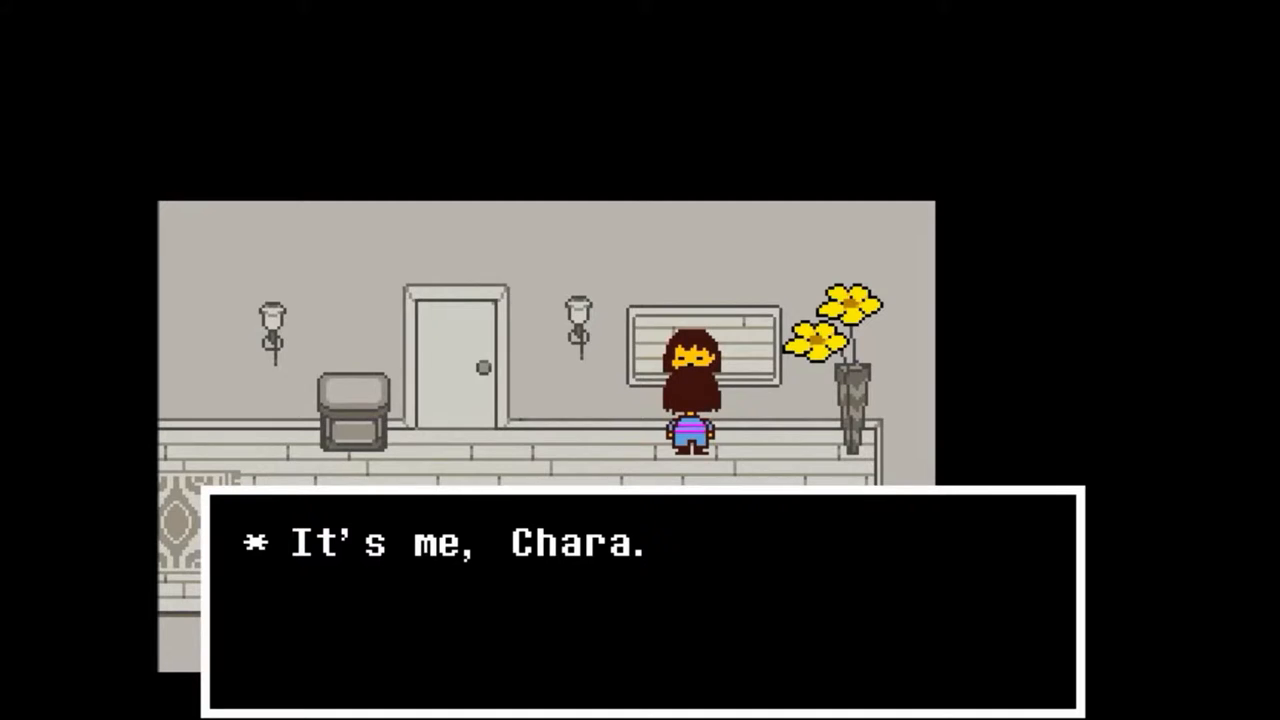 The visible figure is the protagonist and their reflection; the self-identification appears in inspection narration. Original game recording by MetroidMan101. © Toby Fox. Image source ↗
That is unusually direct attribution evidence. It does more than give the narration an ominous tone: it supplies a first-person pronoun and a name. Reading this particular description as Chara's intervention has strong textual support.
What it does not supply is a starting date for that voice. Chara could have been speaking earlier, or could be taking over a role previously occupied by a different narrative voice. Both readings can accommodate this mirror. To choose between them, we need evidence beyond the local self-identification.
The same mirror in a different, non-genocide recording says “Despite everything, it's still you.” It addresses the protagonist but leaves the speaker unnamed. Chara could address someone as “you”; so could another narrator. Second-person wording alone neither establishes nor refutes an all-routes Chara narrator.
Familiarity is weaker evidence than ownership
The left bed in the two-bed room gets an equally economical description on the genocide path: “My bed.” The voice claims a personal connection to an object in the house. Beside the mirror's named self-identification, that possessive strengthens the reading of a particular person's perspective entering these descriptions.
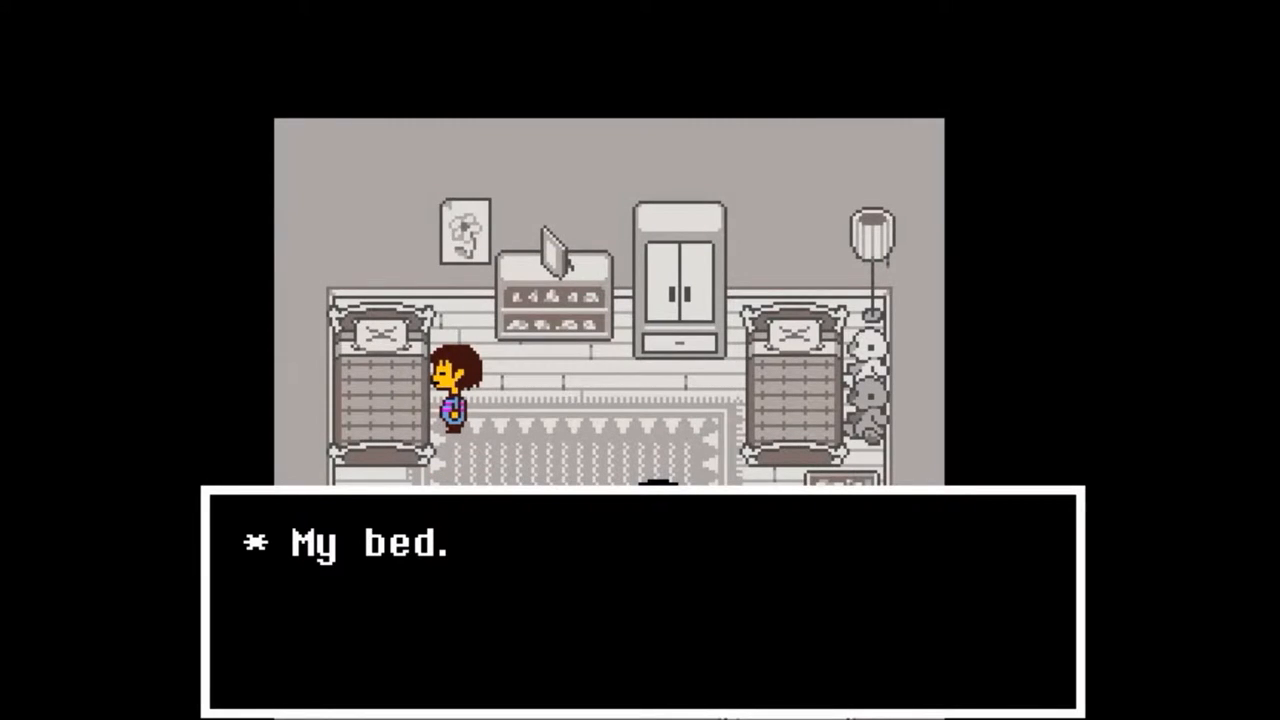 Inspecting the left bed on the genocide path. The possessive can be read beside the mirror’s self-identification. Original game recording by MetroidMan101. © Toby Fox. Image source ↗
In the other recording, the same bed is described as comfortable, followed by an unsettling suggestion that lying down might mean never getting up again. A reader can connect that familiarity to a personal history. But the description does not sign a name or claim ownership.
This is a difference in evidential strength, not a reason to dismiss the theory. Once we adopt Chara as the speaker, ordinary descriptions can become recollections, and a familiar room can acquire a second emotional life. The reading can be persuasive without making every suggestive line an independent identification of its narrator.
A voice is not a complete account of control
These scenes show descriptions triggered by inspecting objects. Assigning those words to Chara does not, by itself, establish who caused a movement, selected an attack, or directed every action on a route. Those are separate claims, requiring evidence about the actions and the timing of an intervention.
The distinction also leaves room for Chara to act elsewhere. It simply prevents the mirror from doing more explanatory work than its text supports. Narrating, being present throughout the story, and controlling a body are three propositions; evidence for one does not automatically prove the others.
A similar problem arises when knowledge of a reset is treated as a memory of living through it. An observation may be real while the explanation attached to it reaches too far.
Scope: two recordings of the released English game's house descriptions, not an exhaustive audit of every route or save variable. Exact recording builds and platforms are unverified; fan games, anniversary expansions and a complete account of ending-related control are outside this reading.
Official sources
- MetroidMan101 — original genocide-path house recording ↗01:17 left bed;02:35 mirror. Original game text delivered by a third-party recorder, not their lore commentary. Exact build/platform unverified.
- Hawlo — original non-genocide house recording ↗03:07 same left bed;04:28.5 same mirror. Video labeled Pacifist. Inspection descriptions, not character-portrait dialogue. Exact build/platform unverified.
Further reading
- The Undertale Wiki — Chara, Speech pattern ↗Existing fan account already distinguishes suggestive narration from uncertainty about the narrator throughout the game. Used as theory context, not primary game proof.
- UNDERTALE official help and licensing ↗Translation statement and merchandise/music rules. Not cited as a blanket screenshot or commercial-use license.