UNDERTALE: Does Sans remember resets?
Scope: Inspected sequences from the original English game: retries, battle reports and corridor codewords. Exact builds and all reset-state branches unverified. Fan games, AUs and later anniversary performances excluded.
Spoilers Spoilers for Sans’s battle dialogue and hidden corridor/codeword conversation, including the room-key reward.
Sans greets a returning protagonist by describing the expression of someone who has died twice in a row. It sounds like a witness remembering the previous attempts. His explanation points somewhere else: the face in front of him.
Sans knows that time can be disrupted. That does not establish that he retains a complete memory of earlier timelines. Undertale gives him several ways to know more than he should appear to know. The useful question is what each scene actually lets him learn.
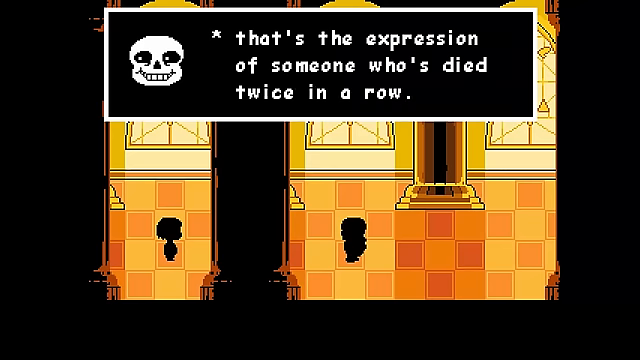 Sans explains the count through the protagonist’s expression. Original gameplay recorded by PK Thunderstorm. © Toby Fox. Image source ↗
A correct count is not a memory test
In the recorded retry dialogue, Sans frames the death count as a reading of the protagonist’s expression. The game supplies that explanation in the line itself; it is not something a theory has to add afterward.
This need not be a realistic account of how facial recognition works. A joke can make Sans implausibly accurate. But accuracy and the source of knowledge are different questions. Getting the number right does not, by itself, establish that he personally recalls the fight that produced it.
There is also a scope problem with the word “reset.” Returning to a saved point and retrying a battle is not the same test as starting over through the RESET menu. A line observed after a retry cannot settle every character’s memory under every kind of restart.
His reports give him another source
“He reads your face” is an incomplete account of everything Sans knows. During the original battle dialogue, he refers to reports of a major anomaly in the timespace continuum. He then describes timelines stopping and starting.
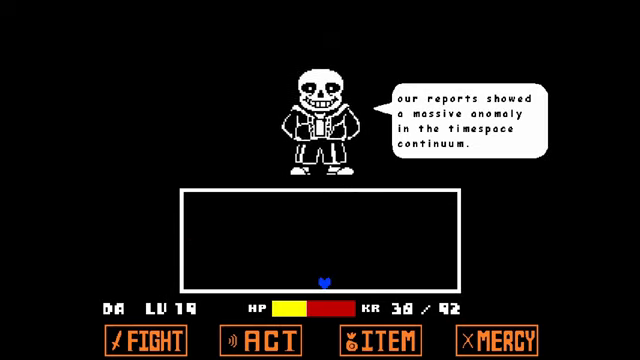 The reports are a source distinct from facial observation. Original English battle screen. © Toby Fox. Image source ↗
That is more specific than a vague feeling of familiarity. Sans explicitly connects knowledge of temporal disruption to reports. It remains different from saying he remembers living through every version of events.
Nor does this speech identify every person behind the reports, the instrument used to produce them, or how any information survives a change in time. Those are possible subjects for theories. The existence of a report does not fill in the whole mechanism, and its plural pronoun does not name a collaborator.
The distinction cuts both ways: it would be an overcorrection to turn all of his knowledge into facial inference. The reports are a separate clue and deserve to remain one.
The password experiment has a messenger
The noncombat corridor conversation offers a clearer demonstration. On a repeated encounter, Sans comments that the protagonist behaves as though they know what will happen. He explains that he has a private codeword: if somebody tells it to him, that person must be a time traveller. The original recording of the sequence shows the returns, further codeword exchanges and eventual room key.
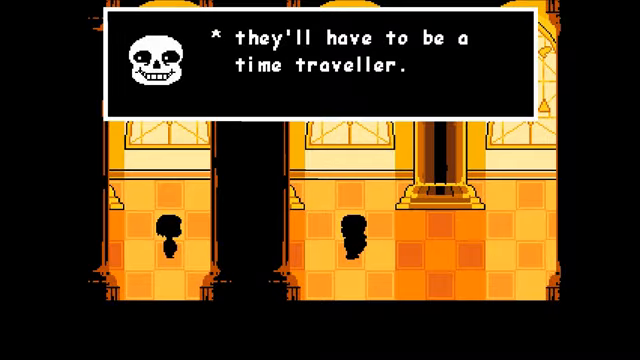 A test for the person returning with his codeword. Original gameplay recorded by willcheat. © Toby Fox. Image source ↗
Here the protagonist carries the information. They hear a word in one encounter and bring it to an earlier Sans. That Sans can recognize his own private word and infer something about the person saying it. He does not need to recall having given it to them in the encounter they remember.
This is why recognition after a reload is not automatically evidence of preserved personal memory. The conversation provides a route by which new evidence reaches him. The protagonist remembers the exchange; Sans evaluates its result in the present.
The scene is a prank, but the information flow is unusually precise. It gives a concrete alternative to treating his apparent knowledge as a record of every previous life.
Taken together, the scenes support an informed, observant Sans who can test a time traveller. They do not establish universal recollection, and they also do not prove that no trace of memory could ever occur anywhere in the game. His expression-reading, reports and password experiment do different work. Keeping them separate explains his apparent foresight without supplying a memory power—or a complete scientific apparatus—that these scenes never specify.
This reading concerns inspected sequences from the original English game. The recordings’ exact builds are unverified; it is not an exhaustive audit of every reset flag, unusual branch or later anniversary performance.
Official sources
- Original retry dialogue, recorded by PK Thunderstorm ↗01:41 expression/twice-in-a-row line. Released game pixels personally inspected; recording title/description is not used as a reset-state audit. Exact patch unknown.
- Original English Sans battle recording ↗00:32.7 report sentence;00:34.7 timeline description. Original game speech, not creator commentary.
- Sans’s corridor codeword sequence, recorded by willcheat ↗02:14–02:25 anticipation/private word/time-traveller test;02:56 returned word;03:54–03:59 final exchange and room key. Recording includes reload transitions. Exact event flags/build unverified.