UNDERTALE: Can Flowey feel emotions without a soul?
Scope: Original English game’s late-game and pacifist post-battle dialogue, plus the separate official fifth-anniversary web vignette. Recording builds/platforms unknown. Fan games and later anniversary battle variants excluded.
Spoilers Major spoilers for Flowey’s identity, late-game dialogue and the pacifist ending, plus the official winter vignette.
A glass of water complicates the idea that Flowey cannot care. In the official fifth-anniversary winter dialogue, he mocks Toriel for falling asleep on the floor. Her account supplies what his leaves out: she woke in bed with an overfilled glass beside her, filled in a way she associates with her son.
Does that mean the soulless flower has regained his feelings? Flowey already experiences fear without a soul. What the game explicitly identifies as missing is his power to love other people and feel compassion. The glass raises a different question: what can a helpful act tell us about that missing experience?
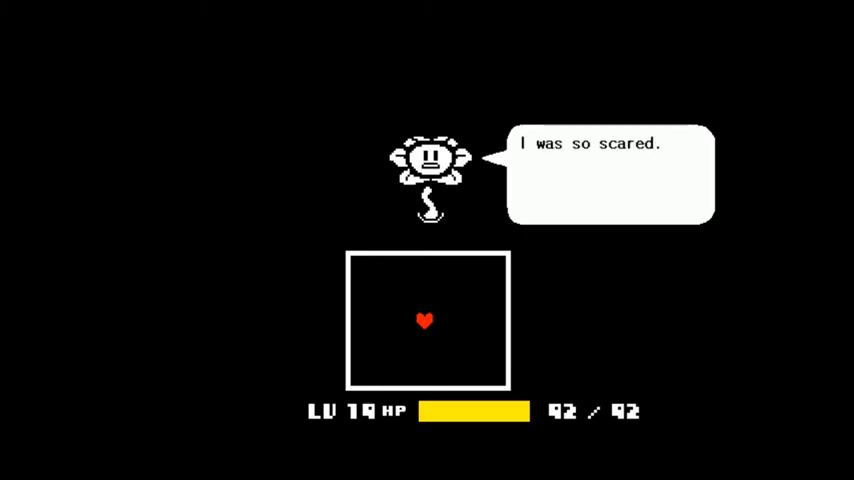 Flowey describes fear in his original-game recollection. Gameplay recorded by Qaladan. © Toby Fox. Image source ↗
The word “anything” has a context
In his late-game account on the genocide path, Flowey describes waking as a flower and being frightened. Later, his description of feeling nothing is directed at anyone. He names the missing capacity as compassion.
That makes a difference to the apparent contradiction. Fear about his own situation and an inability to feel for another person are different experiences. His admission of fear is not merely an expressive face that we might dismiss as a performance. It is part of his own account of life as a flower.
This distinction is already well supported in earlier close reading of the dialogue. It does not require a theory that a soul secretly returned whenever Flowey became upset. Nor does it give us a complete list of which emotions a soulless being can feel.
The pacifist ending offers a separate test. After the final battle, Asriel explicitly connects his former flower state with soullessness and an inability to love others. With the souls inside him, he says his compassion has returned. His earlier fear and this restored relational feeling need not cancel each other out.
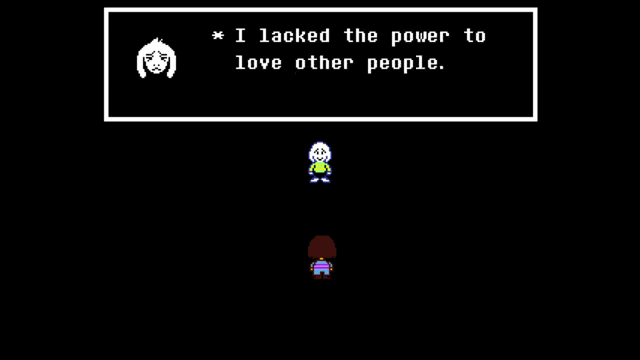 After the final battle, Asriel identifies the capacity he lacked as a flower. Original gameplay recorded by Novaphyer. © Toby Fox. Image source ↗
A kind act is a different kind of evidence
Even before that ending, Flowey says he first used his powers for good. He also describes finding companionship amusing for a while. Helping someone and experiencing love for them are already distinguishable in his account. Soullessness alone does not make helpful conduct impossible, or turn every later act of cruelty into an automatic consequence he could never choose otherwise.
The official winter dialogue takes that distinction somewhere quieter. Flowey remembers finding Toriel in a vulnerable state and laughing at her. She touches his face, addresses him as Asriel, promises not to let him go again, and falls asleep.
Then Toriel recalls waking in bed. A full glass stood beside her. She explains that her son had adopted the habit of filling a glass right to the brim; the glass she found was filled that way. She also recalls a similar glass after the more recent party.
 One panel from the official fifth-anniversary winter dialogue. Its surrounding accounts supply the implication about who left the water. © Toby Fox. Image source ↗
The paired accounts strongly imply that Flowey looked after her. The text does not supply a new soul, a recovery mechanism, or a declaration that he now experiences love normally. An implied action and a confirmed change in inner feeling remain different claims.
This is a creator-published web vignette, rewritten from material for the halted Alarm Clock app, rather than a hidden scene in the original game. It adds to the portrait without requiring us to erase the game’s account of love and compassion. Flowey can speak cruelly about Toriel while the episode quietly points to something he did for her. The water is worth noticing precisely because he never announces it as proof that he has changed.
Official sources
- Original late-game recollection, recorded by Qaladan ↗00:41.5 fear;01:50–01:53 anyone/compassion;04:06–04:14 early good actions and amusement. Released game dialogue delivered by a third-party recorder; exact build/platform unknown.
- Original pacifist post-battle dialogue, recorded by Novaphyer ↗25:08.5–25:15 soulless flower, power to love, souls and restored compassion. Original2015 game footage, not the later anniversary stream variation.
- UNDERTALE fifth-anniversary winter dialogue — Flowey ↗Flowey’s recollection and Toriel’s paired account, panels06–09. Water and overfilling habit imply the action; no explicit declaration of restored love.
- About the official Alarm Clock dialogue ↗Creator’s introduction: an excerpt rewritten for the website from the halted app project.
Further reading
- nochocolate: Flowey’s Ability to Feel (2017) ↗Earlier fan close reading already explains emotion versus love/compassion and helpful conduct. Used as acknowledged context; game claims checked against original footage.