Why don’t the Tal’darim have to cut their nerve cords?
Scope: Legacy of the Void campaign dialogue in Korean, Blizzard’s StarCraft Story Primer, and the published introduction and excerpt of Ascension.
Spoilers Contains spoilers for Alarak’s rebellion against Amon in Legacy of the Void.
Alarak turns against Amon with his nerve cords still intact. If severing them is how the protoss escape possession through the Khala, why does a former servant of that same god get to keep his?
The Tal'darim are not connected to the Khala that Amon has taken over. Intact nerve cords do not, by themselves, establish membership in that link. Serving Amon and being possessed through the Khala are two different relationships.
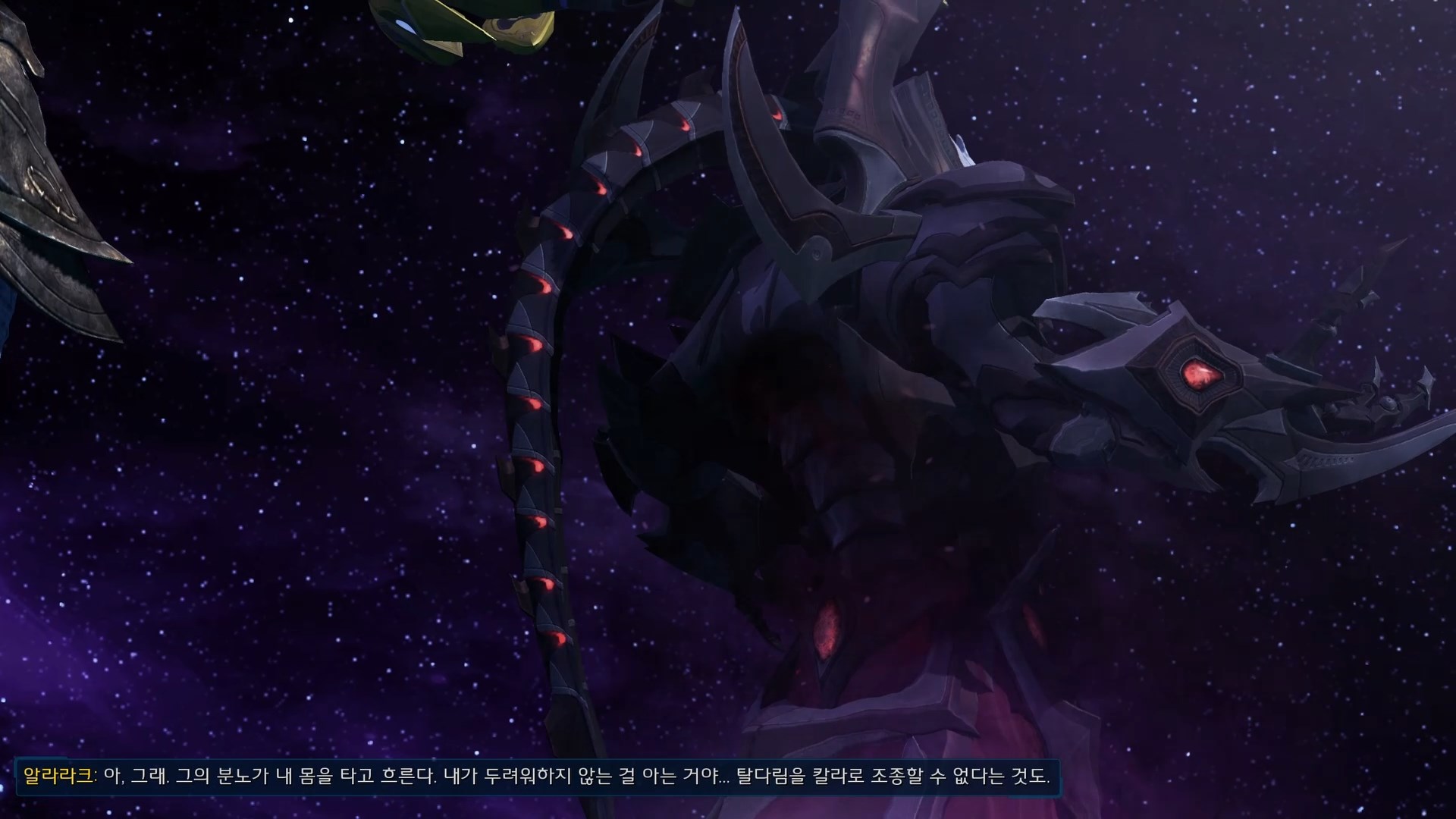 Alarak retains his nerve cords while saying the Tal’darim cannot be controlled through the Khala. Korean game subtitle. © Blizzard Entertainment · 하파타카차. Image source ↗
The route of control matters
In the Korean campaign scene reproduced here, Alarak tells Artanis that Amon knows the Tal'darim cannot be controlled through the Khala. The seventh image contains the line. This is a paraphrase of the Korean localization, rather than a quotation from the English voice track.
Blizzard's StarCraft Story Primer supplies the other side of the comparison: Amon subjugates the Aiur protoss through their shared psionic link. His control has a route. The Tal'darim do not share that connection, so retaining their cords does not place them in the same predicament.
Changing allegiance does not suddenly make cutting his cords necessary. The reason other protoss sever theirs concerns connection to the compromised link.
Following a god is not the same as being possessed
The absence of a Khala connection leaves a different question: why did the Tal'darim serve Amon so faithfully? Blizzard's introduction to the short story “Ascension” describes a society bound by the Chain of Ascension, whose members must obey those above them. The published excerpt also shows Alarak treating a challenge to Amon's immortality as a test of his own loyalty.
Those are relationships of faith and authority. They do not require the same mechanism as Amon taking control of the Aiur protoss. Following a god's commands does not, by itself, mean being connected to the psychic network he has seized.
Nor does this make Tal'darim society free of coercion. In the later campaign conversation, Alarak puts obedience above what his people think. Being outside the Khala does not erase the power of their ruler. How he acquires that authority is the separate question behind Rak’shir and the Highlord's position.
There is one final limit to Alarak's reassurance. In the very scene where he rules out control through the Khala, he also describes feeling Amon's rage. His statement cannot support a blanket claim that the Tal'darim are beyond every kind of psychic influence. It establishes something narrower—and enough to answer the question about his cords: contact with Amon is not the same as possession through the Khala.
Official sources
- Blizzard — StarCraft Story Primer ↗Legacy of the Void section: Aiur protoss and the Khala.
- Blizzard — Ascension short-story introduction ↗Hierarchy overview and the excerpt displayed on this page, not the full story PDF.
Further reading
- Legacy of the Void Korean game scene — Alarak on the Khala ↗Seventh game image. Original game screenshot circulated by a third party; English prose paraphrases the Korean subtitle.
- Legacy of the Void Korean game scene — obedience ↗Fifth game image and preceding exchange. Original Korean game screenshot circulated by a third party.