Why can Artanis help Alarak in Rak'Shir?
Scope: Legacy of the Void: Rak'Shir and its surrounding campaign conversations. Official background articles support the hierarchy; other games' abilities are excluded.
Spoilers Discusses Alarak's challenge, Ma'lash's defeat, and the Tal'darim's response after the duel.
In the Rak'Shir mission, Alarak challenges Ma'lash, but Artanis does much more than watch. His army has to reach Alarak and help him win. If this is a duel for leadership, why is an outside army allowed to decide it?
The rite separates direct combat from psionic support. Only Alarak and Ma'lash can attack each other directly. Nearby supporters can strengthen their chosen combatant. Artanis's forces provide that support. Alarak needs their help to gain something larger than a dead rival: command of the Tal'darim and their death fleet.
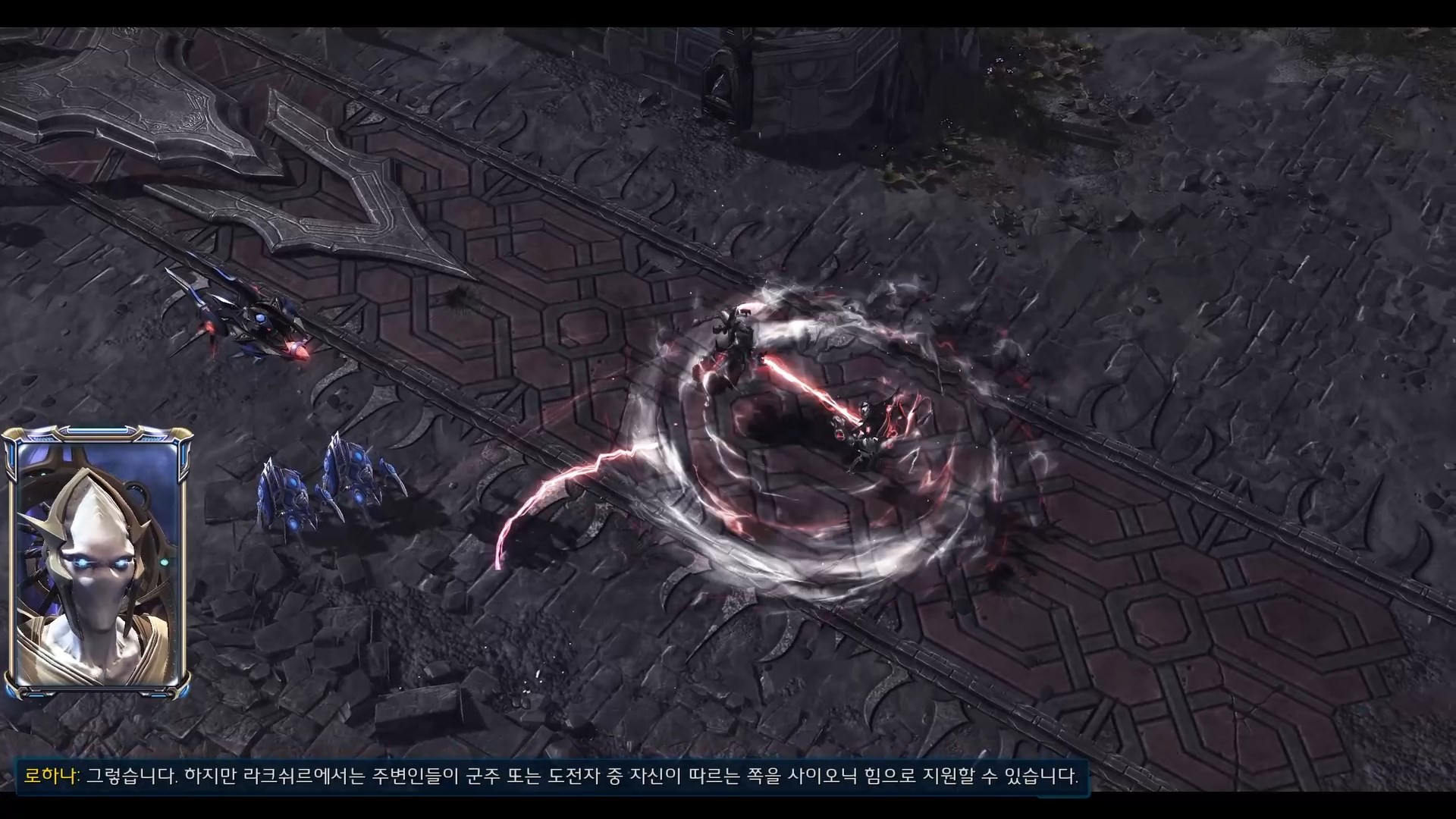 The Korean campaign's support rule, shown beside the duel. Game © Blizzard Entertainment. Screen: 옷게 / 옷장 속 게이머, unchanged. Post license: CC BY-NC-ND 4.0, linked below. Image source ↗
Outside help is part of this duel
The campaign's opening explanation makes the distinction explicit. The two combatants are evenly matched, and their supporters can shift that balance. Artanis's warriors reinforce Alarak while the opposing forces sustain Ma'lash. The linked record preserves the Korean game dialogue and screenshots, rather than an official English transcript.
Blizzard's Alarak character introduction independently identifies psionic aid from Artanis's forces as part of his victory over the previous Highlord. That background paragraph concerns his StarCraft history; the Heroes of the Storm abilities described later on the page are a separate subject.
Calling the army's presence cheating misses the rule the mission actually gives us. The duel tests strength that can be reinforced by allies. Gathering and keeping those allies in position therefore matters to the result.
There is a limit to that answer. This scene establishes that Artanis's forces can support Alarak. It does not provide an exhaustive rulebook allowing any species to enter any Rak'Shir under any circumstances. Nor does a recommended unit composition tell us more about Tal'darim law. The campaign turns the permitted support into a battlefield objective; its tactical details belong to a walkthrough.
Alarak needs the succession, too
Why use the rite at all? Consider what must happen after Ma'lash falls. Alarak wants the Tal'darim available for his revenge against Amon. Removing their ruler and obtaining their obedience are two problems that the ritual can resolve together.
Blizzard's introduction to the short story Ascension describes the Chain of Ascension as a hierarchy that demands obedience to those above. The position at its summit carries authority over everyone below it. That gives Alarak a reason to pursue a recognized victory within the hierarchy.
The campaign shows the result directly: after winning, he invokes the rite and orders the Tal'darim to obey their new Highlord. Reading Rak'Shir as a means of securing command follows that sequence. It does not require assuming that an assassination would have produced the same outcome, or inventing a rule for what every possible coup would entail.
A fleet can obey without being convinced
Alarak's victory speech condemns Amon's false promise. It would be easy to treat the change of leadership as the moment the whole faction accepts the truth. The conversations afterward leave a less comfortable picture.
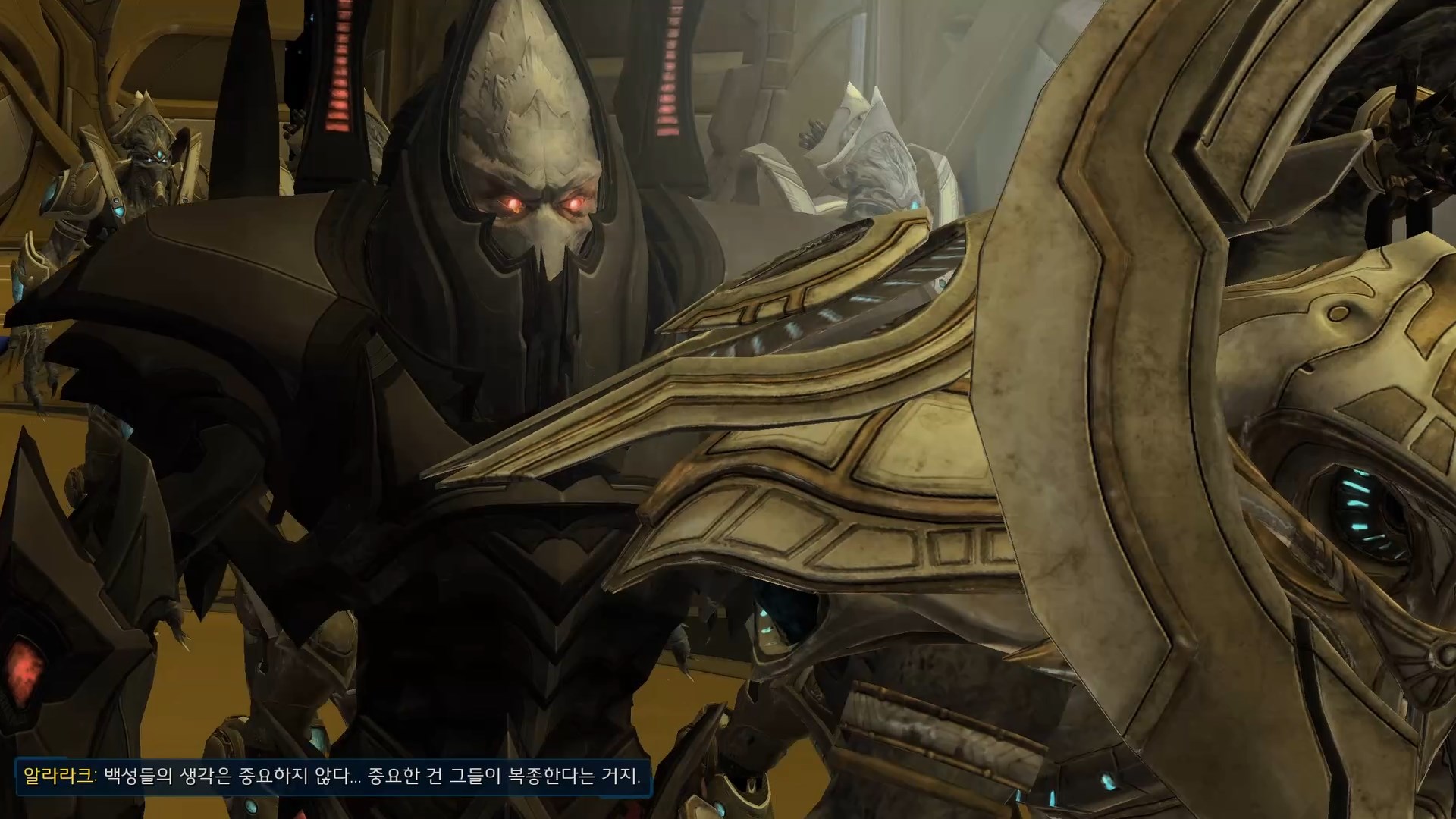 Alarak's answer after winning: he values obedience over agreement. Korean campaign screen. Game © Blizzard Entertainment. Screen: 옷게 / 옷장 속 게이머, unchanged; CC BY-NC-ND 4.0 notice linked below. Image source ↗
In the post-mission dialogue, Alarak reports that the death fleet follows his orders. Asked about his people's response to the truth, he says some have accepted it and the others dare not question him. Their compliance does not establish shared conviction.
That is what makes the outcome revealing. Artanis helps Alarak reach the top of an existing order, and Alarak uses its demand for obedience to turn his people against Amon. He has gained the force he needs without promising to change how the Tal'darim are ruled.
Elsewhere in Legacy of the Void, Artanis's people must sever their nerve cords to escape the Khala's compromised connection. Alarak's story leaves a different question after the break with Amon: how much do followers have to believe, when their new ruler is satisfied that they obey?
Official sources
- Alarak Hero Week ↗Opening StarCraft biography: psionic aid, Highlord title, death fleet. Later Heroes abilities are separate.
- Legacy of the Void Short Story: Ascension ↗Web introduction to the Chain of Ascension; not the full PDF.
Further reading
- Rak'Shir — Korean campaign screens ↗Third-party record, 2022-12-20. Opening support rules and victory scene.
- After Rak'Shir — Korean campaign dialogue ↗Third-party record, 2022-12-22. Fleet command, obedience and partial acceptance of the truth.
- Screenshot post license: CC BY-NC-ND 4.0 ↗Applies to the uploader's contribution; underlying game rights remain Blizzard's.