Did Tassadar return from death? The Ouros reveal explained
Scope: Original StarCraft, Wings of Liberty and the Legacy of the Void epilogue; official retrospective and writer Q&A.
Spoilers Reveals the apparition’s identity and the epilogue’s essence transfer to Kerrigan.
Tassadar dies destroying the Overmind in the original StarCraft. Yet in Wings of Liberty, he appears over its remains and tells Zeratul that he has never tasted death. Is the sacrifice being undone?
No. The apparition is Ouros, a xel'naga using Tassadar's form. Legacy of the Void reveals who was speaking; it does not turn the original Tassadar into a surviving god. The difficult part is separating that later answer from what the earlier scene lets Zeratul—and the audience—believe.
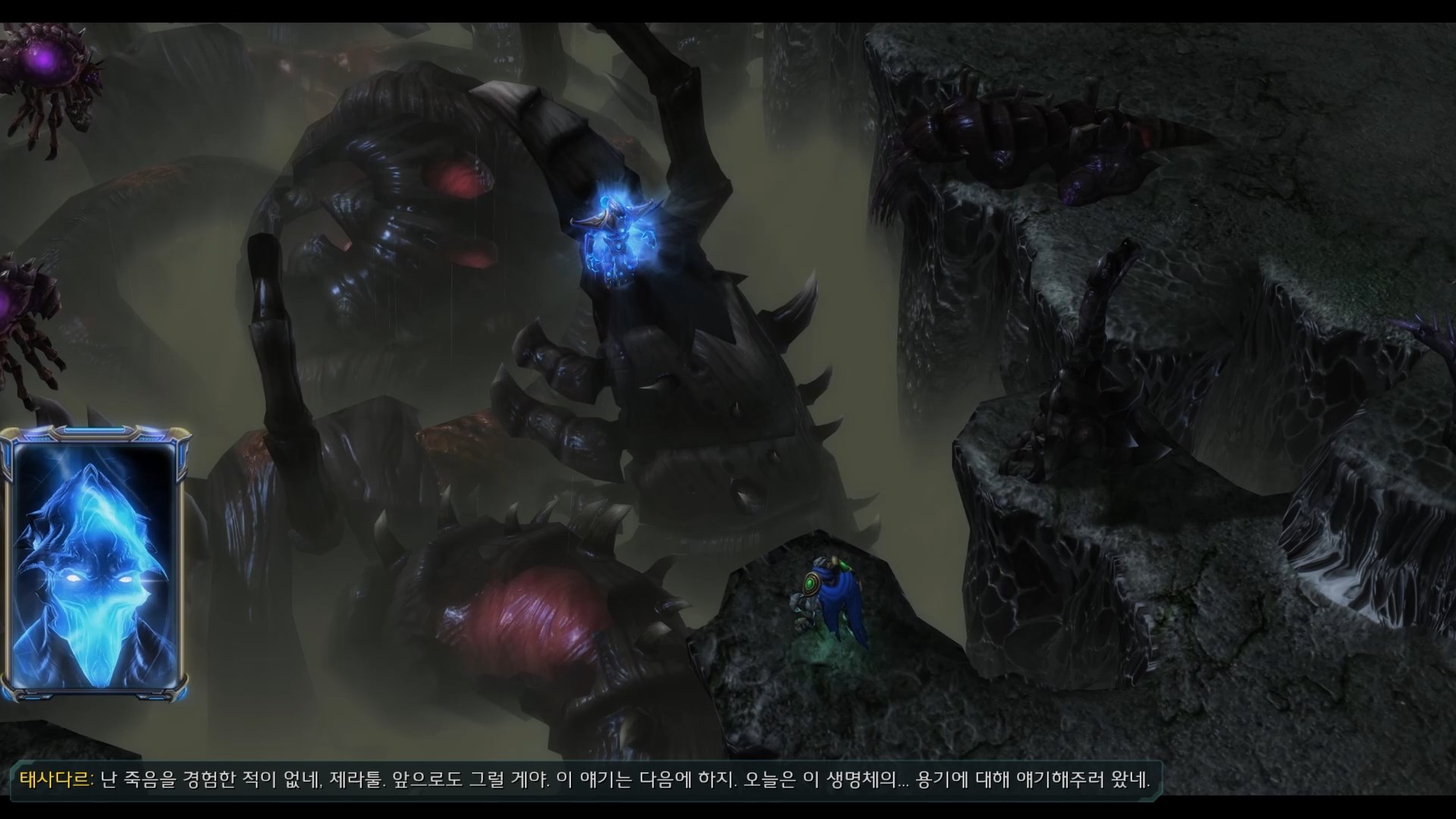 The apparition in Echoes of the Future, Korean campaign. Game © Blizzard Entertainment; screen by 옷게, unmodified. CC BY-NC-ND 4.0 link below. Image source ↗
The sacrifice belongs to the original game
Blizzard's Story Primer still describes Tassadar's final attack as a sacrifice. He channels void energy into his carrier and rams the Overmind. This happens at the end of the original StarCraft campaign, before Brood War.
That matters because there are two different events to explain: the protoss hero dies, and a figure resembling him later appears. A familiar face does not, by itself, make the second event a resurrection.
In Wings of Liberty's “Echoes of the Future,” Zeratul objects for exactly that reason: Tassadar died killing the creature beneath them. The apparition denies having experienced death, then postpones the explanation. It redirects the conversation toward the Overmind and Kerrigan instead. The English campaign transcript preserves that exchange; the Korean game screen above shows the same moment.
The scene encourages a supernatural reading without explaining the mechanism. Its speaker label says Tassadar, but the unresolved identity is part of the scene, not an answer supplied by that label.
Ouros explains the borrowed face
The decisive evidence is the epilogue’s identity-reveal cinematic. Artanis recognizes his mentor and begins an emotional greeting. The apparition gives way to a xel'naga.
At roughly 0:23, Ouros explains that he chose Tassadar's form to move Zeratul and Artanis to act. He also identifies his psychic involvement in the prophecies Zeratul followed. This is a disclosure of impersonation, not a scene in which Tassadar ascends into Ouros.
Artanis's response makes the choice of face understandable: the figure already means something to him. Reading it as an appeal to an existing bond fits both his greeting and Ouros's explanation. It does not establish direct mind control.
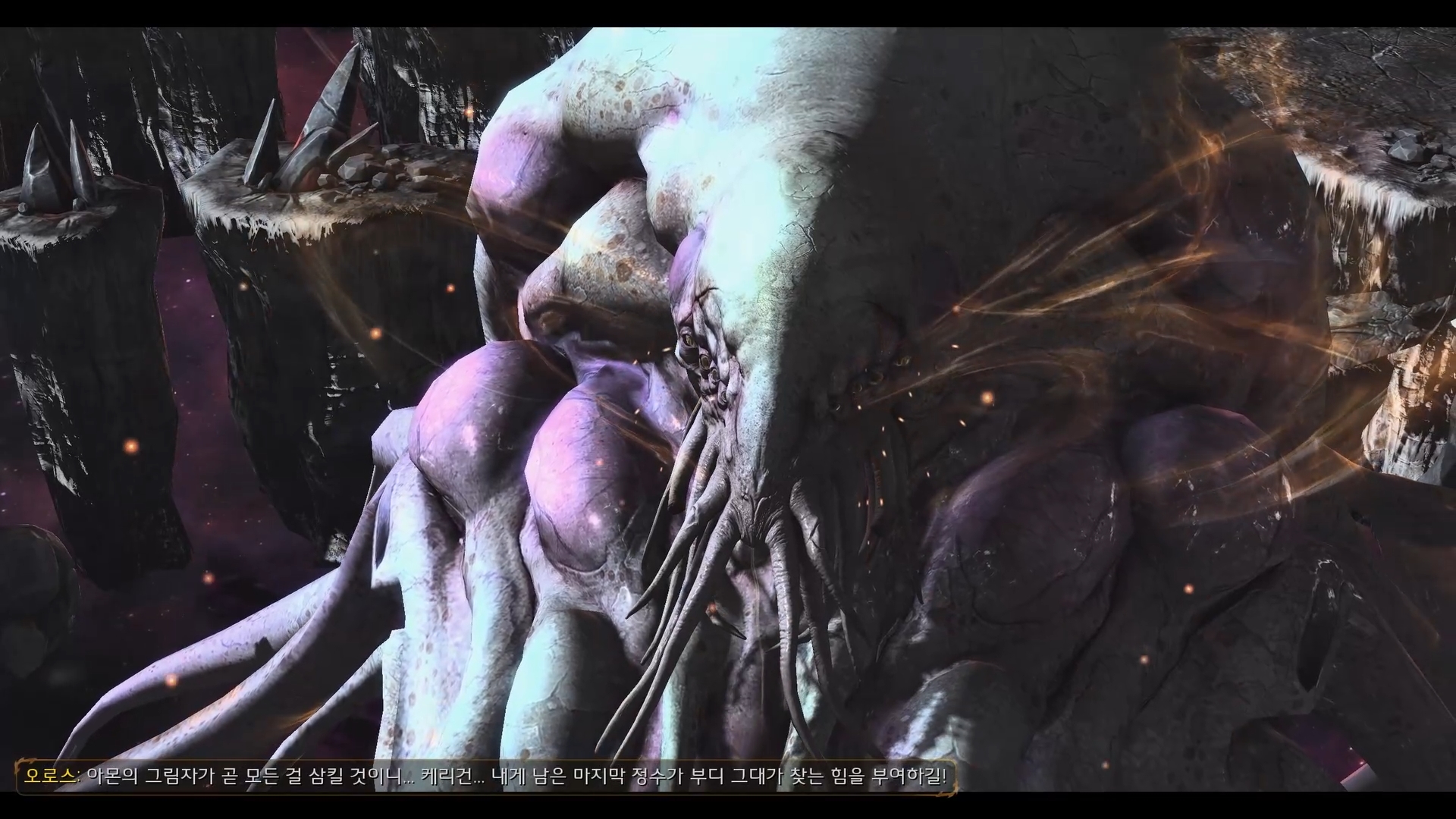 Ouros after the identity reveal, during the essence transfer. Game © Blizzard Entertainment; Korean screen by 옷게, unmodified. CC BY-NC-ND 4.0 link below. Image source ↗
This later image shows Ouros during the transfer of essence to Kerrigan, after the revelation. He is the being behind the appearance, not a new body awarded to Tassadar for destroying the Overmind.
What the reveal does—and does not—settle
Once the speaker is identified, the claim about never dying cannot serve as evidence that Tassadar survived. Nor should a single character's sweeping claim become a universal rule of xel'naga immortality.
There was ambiguity before the reveal. In Creative Development Q&A 10, the writer rejects a question's assumption that the apparition is all-powerful and points to restrictions associated with the Overmind's location. That answer does not disclose Ouros. It also cannot establish exactly when every part of the final plot was decided.
The released story resolves the identity. Whether the transition is satisfying is an assessment of its storytelling, not a reason to treat Tassadar and Ouros as one person. Zeratul was given a familiar messenger; the hero whose face that messenger wore still made his sacrifice. What the messenger says about the Overmind's purpose for Kerrigan needs its own evidence, rather than borrowing certainty from the face above the corpse.
Official sources
- StarCraft Story Primer ↗Part 2: The Fall; Part 6: Legacy of the Void.
- Creative Development Q&A 10 ↗Second question and answer, before the identity reveal.
Further reading
- Echoes of the Future — Korean game screen ↗Mission epilogue. Gameplay captured by 옷게; original game by Blizzard.
- Echoes of the Future — English transcript ↗Fan-site transcription of the final Zeratul–Tassadar exchange.
- Epilogue — identity reveal ↗0:05–0:41: Artanis greeting and chosen form. Released English game scene, uploaded by xLetalis.
- Later epilogue mission — Ouros game screen ↗Opening essence-transfer scene, after the reveal; Korean gameplay by 옷게.
- Screenshot publisher license — CC BY-NC-ND 4.0 ↗Uploader contribution; game rights remain with Blizzard.