Outer Wilds: Why is Solanum both alive and dead?
Scope: Released base-game lunar encounters, Solanum dialogue and comet-core warning. Exact recording builds/platforms unknown. No finale or expansion plot, exhaustive corpse-state survey or real-physics model.
Spoilers Reveals the Quantum Moon’s sixth-location encounter and the local Nomai catastrophe. Read after exploring those mysteries.
“Five-sixths dead” is a useful shorthand for Solanum’s predicament. It becomes misleading if it sounds like a health bar, six separate people, or a one-in-six chance of finding her alive. The distinction is between the Quantum Moon’s locations: the encounter with a living Solanum belongs to its sixth location, while her corpse remains in its other states.
That explains how the two encounters fit together. It does not, by itself, explain every detail of her consciousness or how time passes for her.
A corpse that the conversation does not remove
The contrast is especially clear in AeKoP’s original game recording. At the sixth location, Solanum stands beside the conversation stones. After the player leaves that area, the suited body is still at the moon’s south pole. Meeting her has not healed that body or erased it.
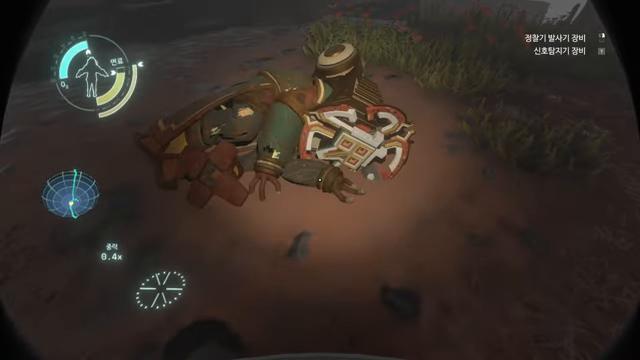 The body remains in another lunar state after the sixth-location conversation. Korean game recording by AeKoP. © Mobius Digital. Image source ↗
The player’s order of discovery can make this feel like a resurrection: first a body, then someone to talk to. But the change being demonstrated is a change of lunar state. Solanum also explains that the moon’s appearance varies with its location. Her condition belongs in that comparison, rather than in a sequence where the protagonist reverses her death.
The usual explanation connects this distribution to the disaster that killed the local Nomai. In the original recording inside the comet, a researcher warns that a rupture would release lethal matter across the star system almost instantly. The core the player finds is already broken.
Read alongside the lunar encounters, the established interpretation is that Solanum died in the states exposed to that disaster, while the distant, Eye-near state was spared. This is a synthesis of the catastrophe and the moon’s differing states, not a line in which Solanum gives a complete account of her own death.
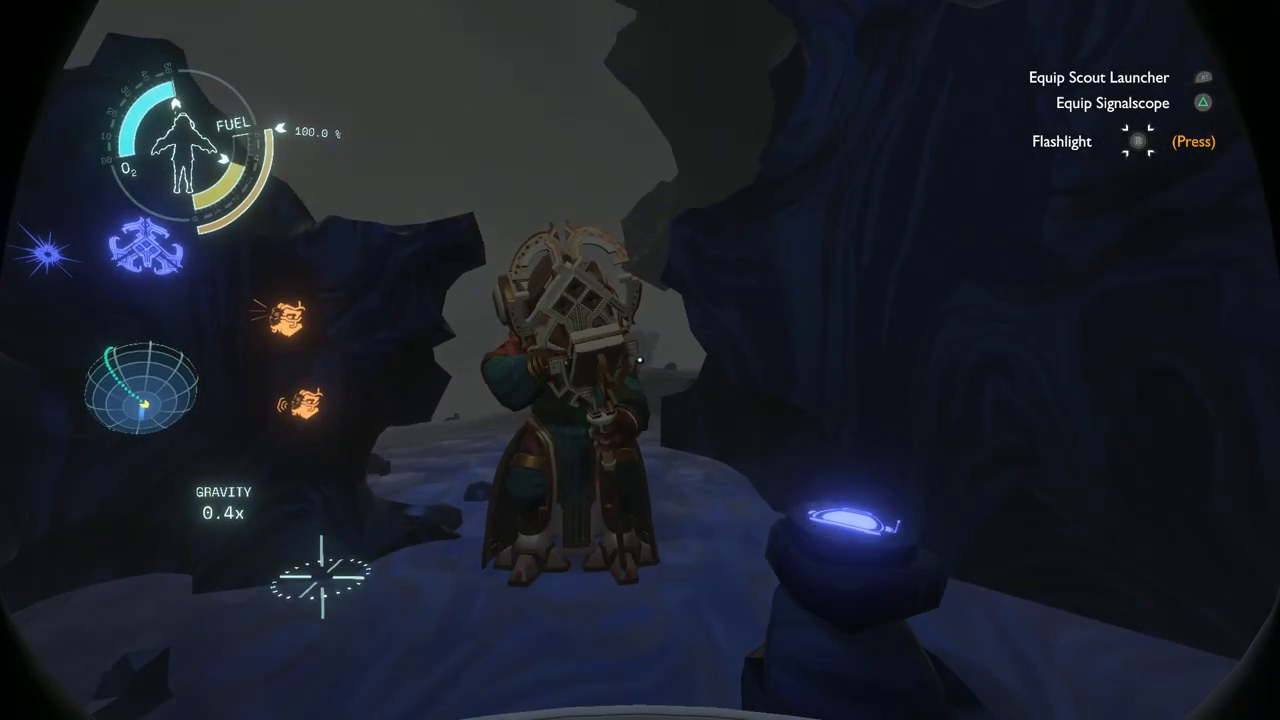 The encounter includes gestures and responses to the conversation stones. Original game recording by meep. © Mobius Digital. Image source ↗
Nor is the living encounter merely a recording playing over the corpse. She responds to the stones presented to her and produces writing to answer them. Accepting that encounter does not require treating her as ordinarily alive in every state of the moon.
Her own answer is a hypothesis
Solanum’s wording is more cautious than many explanations of her condition. In the conversation about herself and the moon, she says: “I have a hypothesis that I may not be entirely alive.” She then suggests that her journey may have ended.
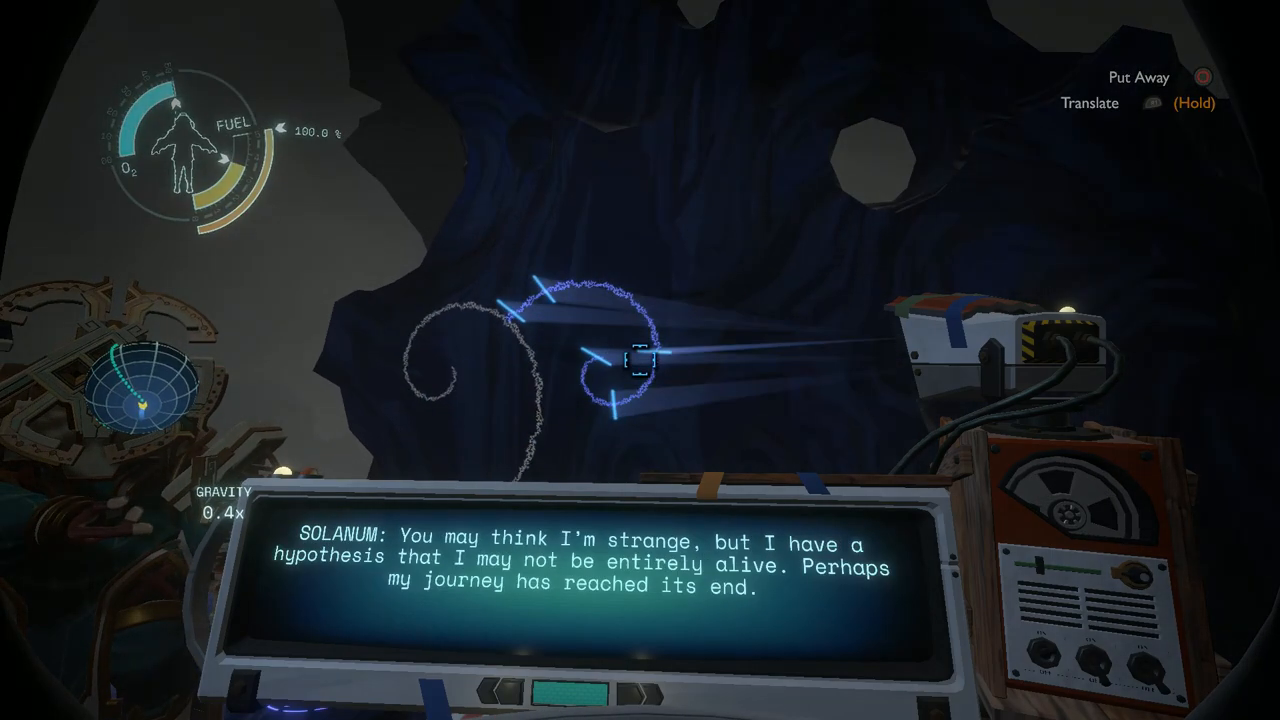 Her statement is a hypothesis about her condition, rather than a confirmed mechanism for stopped time. Original game recording by meep. © Mobius Digital. Image source ↗
The word hypothesis matters. This is an assessment made by the person we meet, not an omniscient statement of the rules governing her. It supports taking her unusual condition seriously without making her certify a precise mechanism she never describes.
The same distinction helps with time. Her presence long after the local Nomai disappeared makes an ordinary account of her elapsed lifetime difficult. But that does not measure her experience in minutes, establish an exact time-dilation factor, or prove that the sixth location stores every past visitor forever. “Time behaves strangely here” and “all earlier pilgrims must still be here” are different claims.
The observer problem remains a problem
Solanum herself supplies the strongest objection to an overly tidy explanation. She describes conscious observation collapsing a quantum object to one possibility. If she can perceive and communicate, why does her presence not permanently fix the moon at the sixth location?
Her incomplete aliveness is a possible part of an answer. The inspected dialogue does not specify the exception, however. It does not establish that she is blind, that she exists only while someone else watches her, or exactly what makes her count—or fail to count—as an observer.
Those proposals try to explain a real tension in the game’s presentation. They should retain that status as proposals. The conversation gives us a Solanum who can question her own condition; it does not give us a finished theory of how that condition works.
Unofficial fan commentary under the Mobius Digital Fan Content Policy. Neither approved nor endorsed by Mobius Digital.
Official sources
- meep — original Solanum conversations ↗00:14 responsive encounter;02:15 self-state hypothesis;03:00 self-identification;03:25 pilgrimage continuation;06:00 observer rule. Third-party delivery of original game writing.
- AeKoP — original Quantum Moon exploration ↗13:00 onward sixth-location encounter;16:55 corpse after leaving. Korean original game text; exact localization/build/platform unknown.
- IGN Guides — original comet-core record ↗08:55 historical recording page6/9 beside the ruptured core. The warning is conditional; interpretation is distinguished from the speaker’s literal words.
- IGN Guides — Quantum Moon route and shrine ↗02:40–06:30, location icons and changes through darkness. Uploader instruction overlays are not game dialogue.
Further reading
- Outer Wilds Wiki — Solanum ↗Existing fan account already explains five dead states/one living state and speculates about time. Context, not a replacement for the original scenes.
- Mobius Digital Fan Content Policy ↗Current full policy and FAQ read for free, unofficial commentary and limited intact stills.