Outer Wilds: Why were there 9 million probes before your first loop?
Scope: Released base-game records in the Probe Tracking Module, the statue-makers’ workshop, Ash Twin Project and Sun Station. Recording builds/platforms unknown; alpha and DLC-specific plot excluded.
Spoilers Major base-game spoilers for the probe search, memory statues, Ash Twin Project and the cause of the sun’s explosion. Best read after exploring those mysteries.
The Probe Tracking Module gives you two numbers, and they answer different questions. In the recording shown here, 9,318,105 is the total number of probes launched. 9,318,054 identifies the probe that found a match for the Eye of the universe.
Neither number counts the adventures you remember playing. The search was accumulating data before the museum statue paired with the protagonist. Your first remembered loop begins when that long-running search succeeds, not when the machinery first starts working.
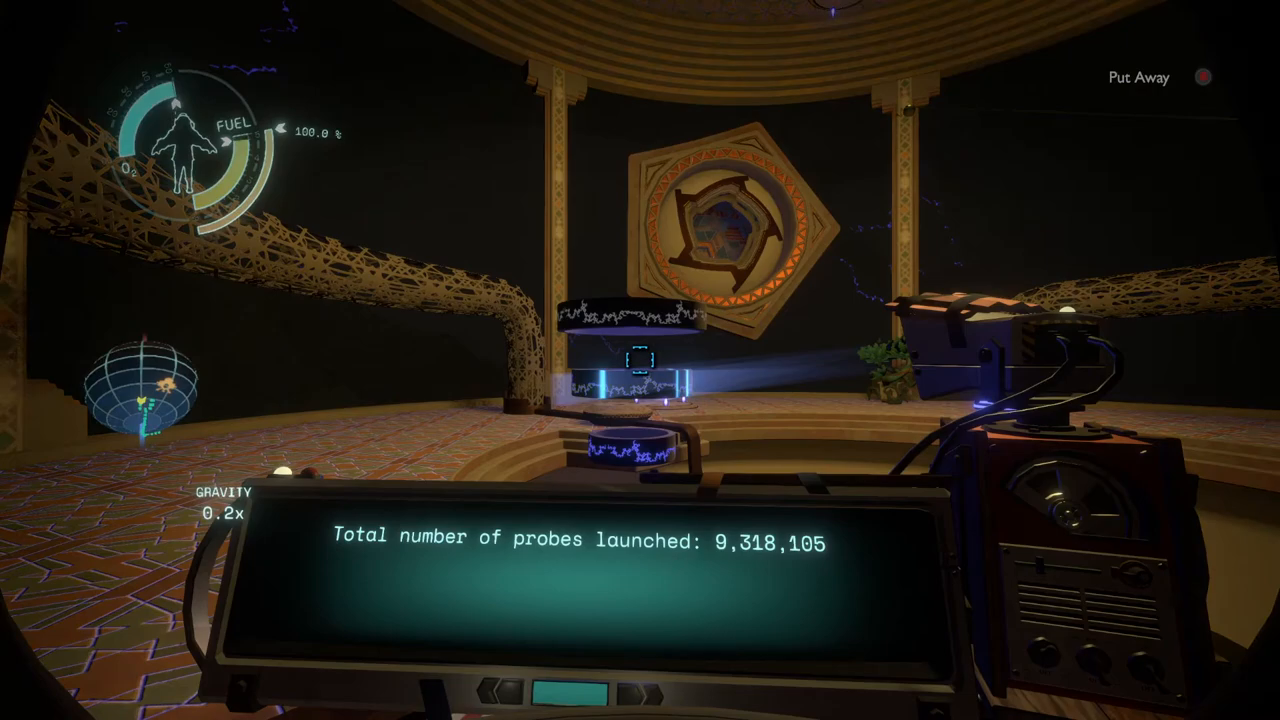 Total launches and the successful probe are separate readouts. Original gameplay recorded by Alan Malloy. © Mobius Digital. Image source ↗
The two readouts are a useful way to check the explanation. The successful-probe number records a discovery. The total can keep rising afterward. A later visit can therefore show more launches than the number attached to the discovery, without changing which probe found the Eye.
Read the loop as a message chain
Inside the Ash Twin Project, the original design sequence describes using supernova energy to send the order to fire the Orbital Probe Cannon 22 minutes into the past. The underwater module records the probe’s trajectory and transmits its information; the search does not depend on someone watching each launch.
Follow the information rather than a pile of physical probes: a firing order arrives from the future, a probe searches, its data is recorded, and the supernova supplies the energy to send information back for another attempt. The next attempt can carry the accumulated search history even though a person who has not paired with a statue remembers none of it.
That is why “Who was there to remember?” has a mechanical answer. The system has a data receiver. It does not need an aware astronaut to act as its notebook. Nor does the launch total mean that millions of probes were fired during one 22-minute interval.
A data link is not a personal memory link
The live terminal inside Ash Twin makes the distinction unusually visible. Its reception list names the Probe Tracking Module separately from the memory statues on Giant’s Deep and Timber Hearth.
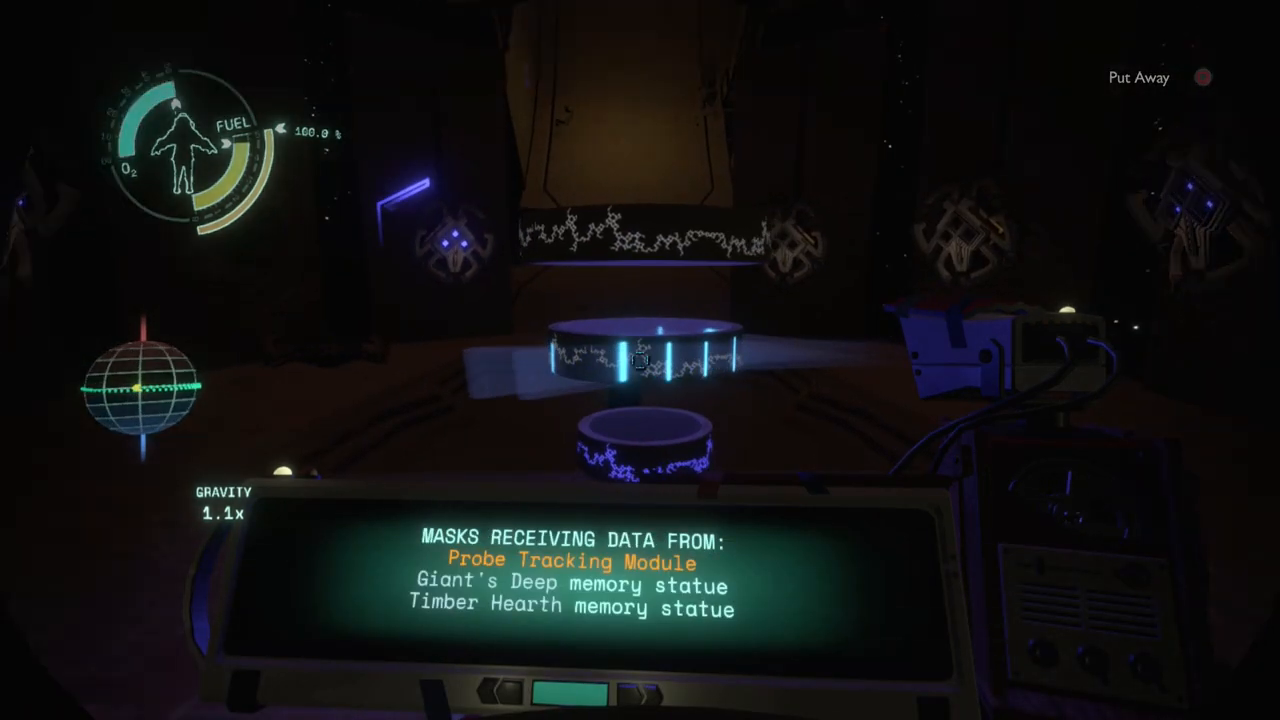 Ash Twin’s reception list distinguishes probe data from personal memory links. Original gameplay recorded by IGN Guides. © Mobius Digital. Image source ↗
The statue-makers’ conversation supplies the missing condition: ideally, the personal statues activate once the project succeeds. They also activate in the event of equipment failure. Another part of that conversation describes masks returning stored memories to the corresponding person.
Those are two different starting points. The module can preserve search information throughout the attempts. Personal pairing lets someone become aware of the repetition when there is a result—or a problem worth noticing. The museum encounter belongs to the successful search, so it introduces you to a process that already has millions of attempts behind it.
Keep the failure clause, but use it carefully. Damage to the launcher does not, by itself, establish that the data-retention system has failed. The module is still displaying accumulated launches and a successful detection. These records explain the separate data paths; they do not specify every possible equipment-failure trigger.
Finding the Eye is not a shutdown command
The original design leaves stopping the cycle to its operators, explicitly describing their ability to end it at will. Activating the statues makes a result available to people; it is not the same operation as shutting down the project.
The difference between the successful-probe number and a larger total is therefore meaningful. The search has answered its question, while the machinery continues to run. Your remembered attempts begin after the discovery, rather than adding up to the millions needed to make it.
Supernova power does not mean the Sun Station worked
There is one more distinction to preserve when tracing the power supply. The original plan called for the Sun Station to cause an explosion. The historical wall records report that the attempt failed and the station could not make the sun explode.
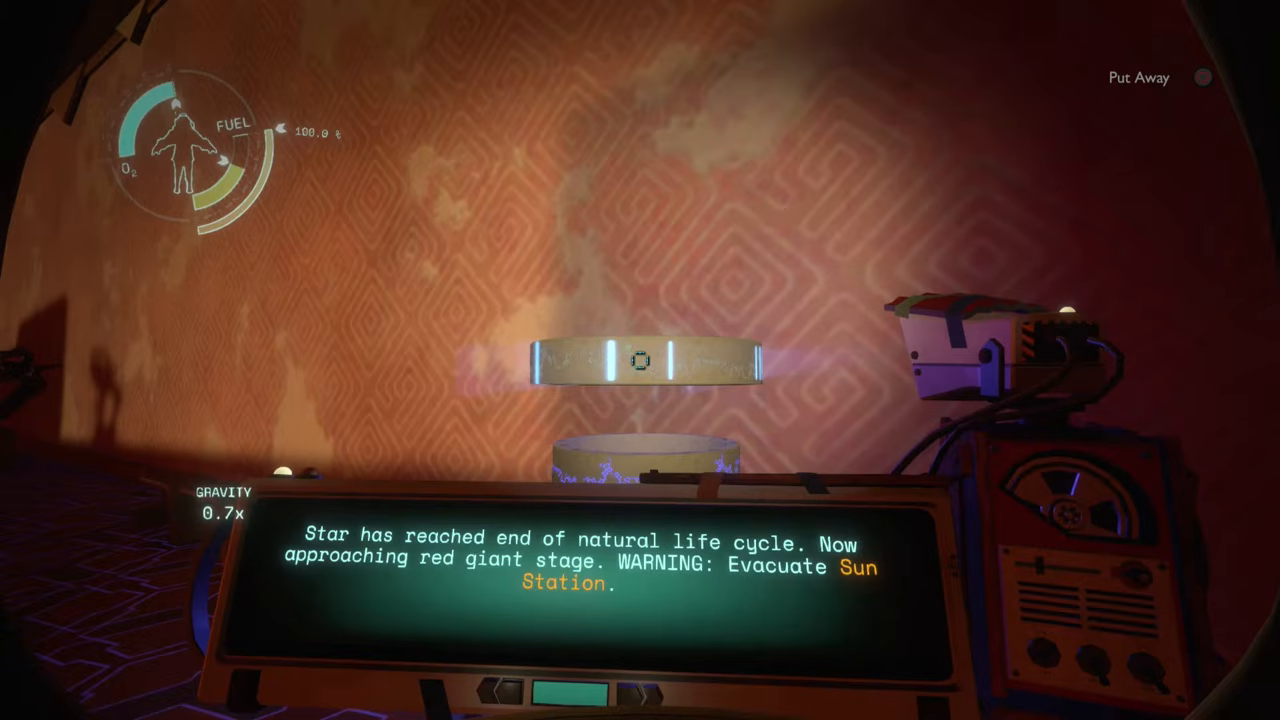 The current status report must be distinguished from the earlier experiment. Original gameplay recorded by IGN Guides. © Mobius Digital. Image source ↗
The current automated terminal reports something else: the star has reached the end of its natural life cycle. Its supernova can supply the Ash Twin Project with energy without turning the failed Sun Station into the cause of the present catastrophe.
The discovery solved a search problem. It did not restore a dying star.
Unofficial fan commentary under the Mobius Digital Fan Content Policy. This work is neither approved nor endorsed by Mobius Digital.
Official sources
- Original Probe Tracking Module records, recorded by Alan Malloy ↗26:22 discovery alert; 28:08 total 9,318,105; 28:11 successful probe 9,318,054. Game records delivered in third-party footage; recording build/platform unknown.
- Original statue-makers’ dialogue, recorded by Senkara ↗09:30 stored memories returned via masks; 10:28 success/equipment-failure activation conditions. Original translated wall records, not uploader commentary.
- Original Ash Twin Project records, recorded by IGN Guides ↗05:30 live receivers; 09:02 firing order sent 22 minutes back; 09:18 design cycle and operator shutdown. The wall’s original plan is distinguished from current status.
- Original Sun Station records, recorded by IGN Guides ↗04:22 current natural-life-cycle report; 05:12 the historical failure statement. These are separate media/time contexts.
Further reading
- Mobius Digital Fan Content Policy ↗Current free/unofficial-use guidance and FAQ, reviewed for the limited credited material in this independent article.