Stardew Valley: Why do the Dwarf and Krobus fight?
Scope: Released game sewer encounter and the island volcano shop. Native Korean screens and English recordings are compared; exact recording patches and a complete neutral war chronology are unverified. Mods are excluded.
Spoilers Spoilers for the Dwarf–Krobus sewer encounter, its resolution and a merchant in the island volcano.
The Dwarf has lost a family. Krobus says his people lost their ancestral home. When the two meet in the sewer, those grievances become accusations, then a fight.
Their conflict grows out of the old war between dwarves and shadow people. The encounter explains why that history remains personal, but it offers a much smaller resolution than either a complete account of the war or instant friendship.
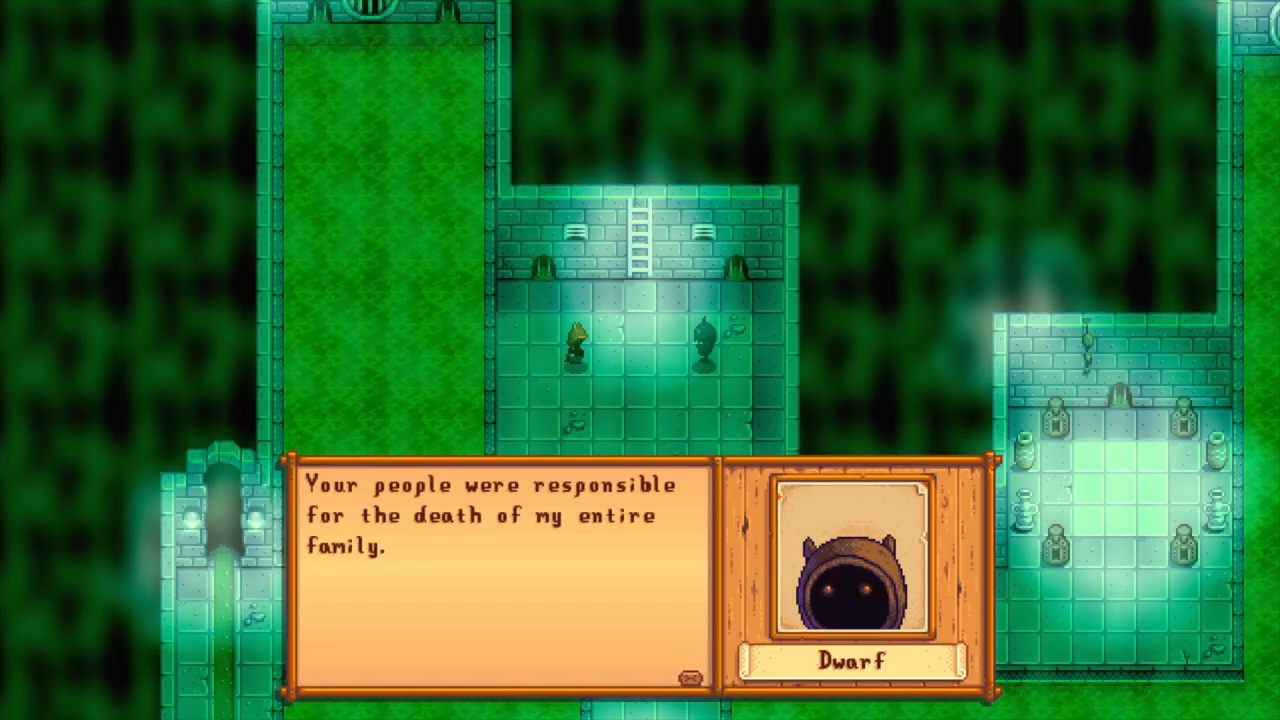 The Dwarf describes the loss of a family. Original English gameplay recorded by Joey’s Quest. © ConcernedApe. Image source ↗
Two grievances in one sewer
In the original encounter, the Dwarf holds Krobus’s people responsible for the family’s deaths. Krobus responds that the dwarves drove his people from their ancestral home, presenting their violence as a response to displacement.
Both statements matter. Leaving out the displacement makes the shadow people’s violence appear unprovoked. Leaving out the family reduces the Dwarf’s anger to an abstract dislike of another species. The scene gives each character a grievance that the other’s account does not erase.
It also leaves a limit on what we can conclude. Krobus alleges that displacement came first; the game is showing him make that case in an argument. This exchange alone is not a neutral chronicle establishing every cause, perpetrator and stage of the war.
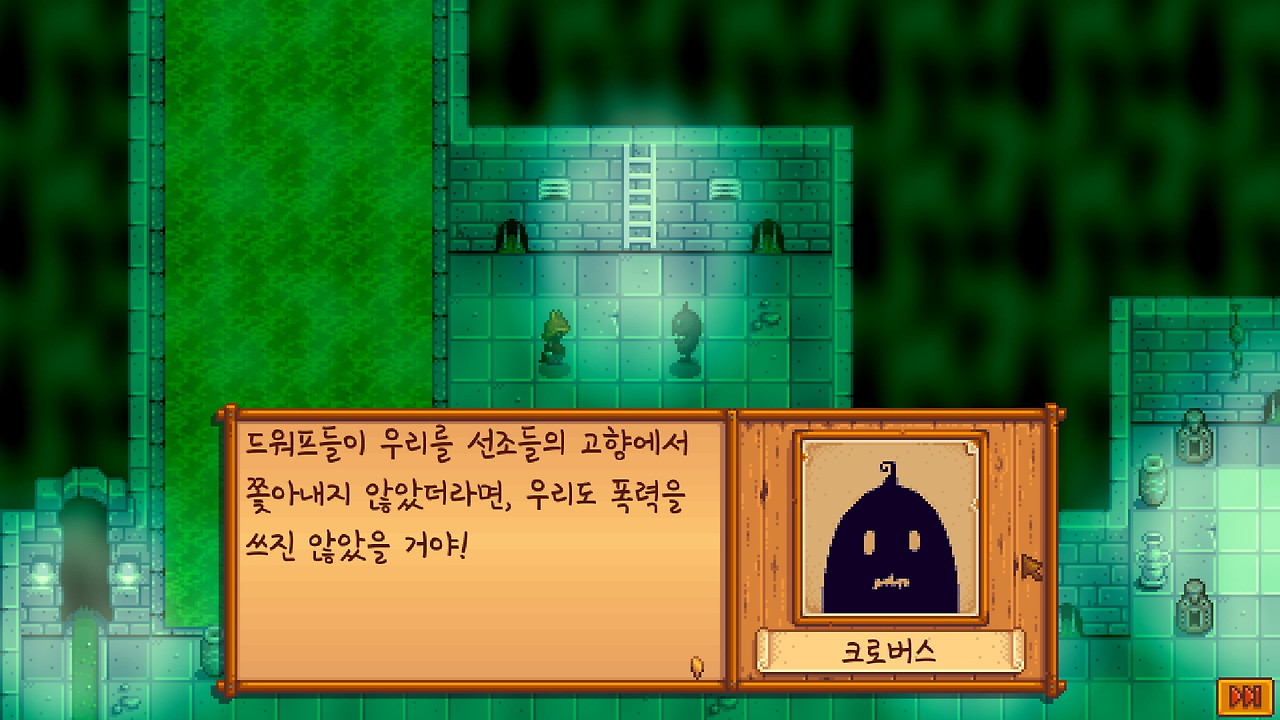 Krobus counters with his people’s displacement. Original Korean game screen shared by 라-루나. © ConcernedApe. Image source ↗
Nor does Krobus confess to personally killing this family. The Dwarf’s accusation addresses “your people.” Krobus expresses sorrow, but an apology for the past and an explanation of collective violence do not identify him as the individual killer. His later statement that he has no personal grievance with the Dwarf makes that distinction especially relevant.
The encounter shows a continuing conflict between two peoples. It does not supply a verified personal combat history for Krobus.
A dead family is not an extinct people
Descriptions of a vanished dwarven society can blur another boundary. Losing an entire family does not mean every dwarf died, or that the shopkeeper in the mines is the last survivor.
The island’s volcano contains another dwarf merchant. This original game screen, reproduced by PlayerAssist, provides a straightforward counterexample to the last-survivor reading.
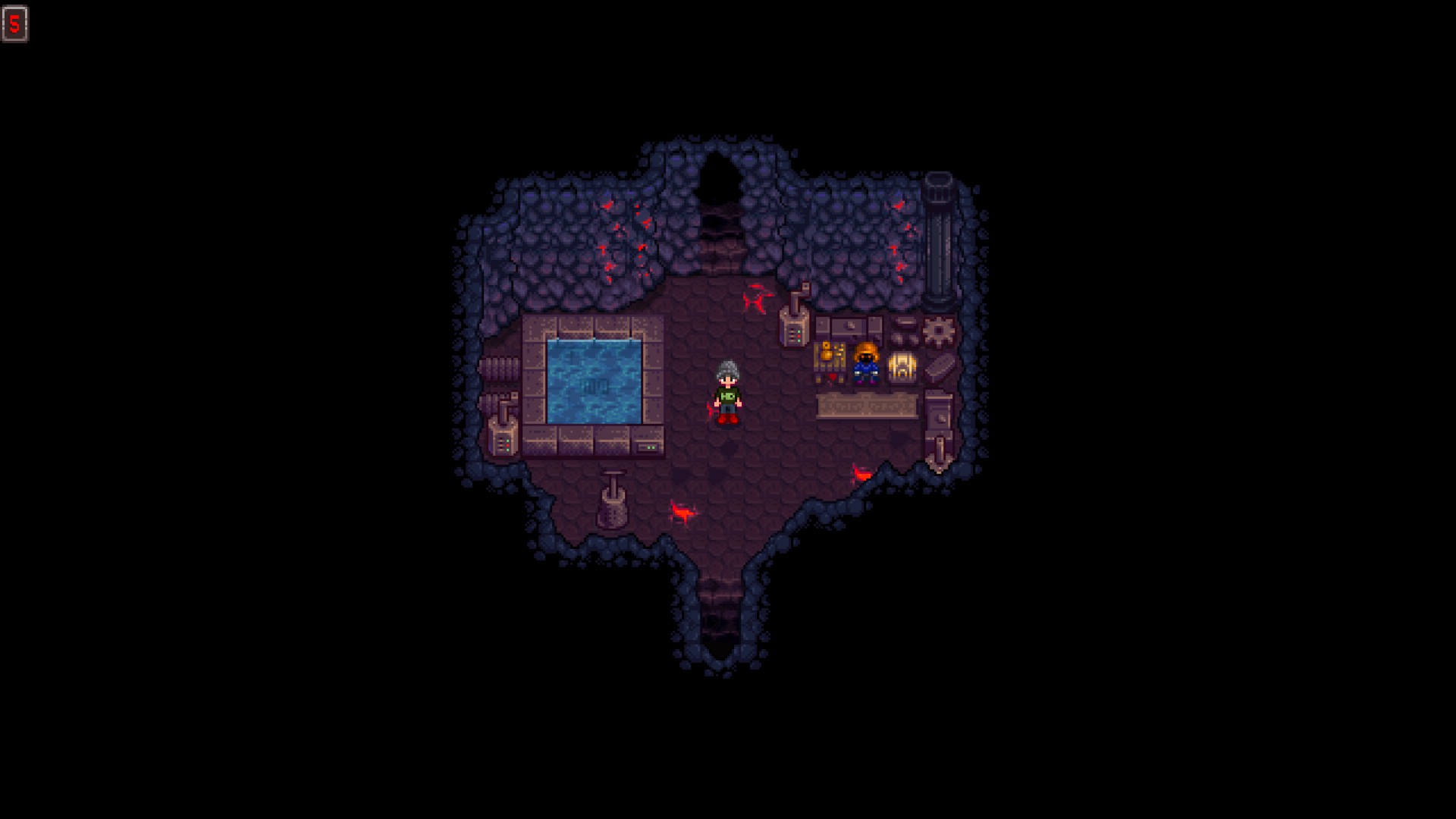 A living dwarf merchant outside the mines. Original game screen reproduced by PlayerAssist. © ConcernedApe. Image source ↗
That merchant tells us very little about population size or wartime casualties. An old society’s decline, the loss of particular families and literal extinction are different claims. A surviving shop cannot settle the first two, but it prevents us from treating the third as the inevitable meaning of the Dwarf’s accusation.
There is no need to make the tragedy larger to take it seriously. The family loss the character describes already explains why meeting a shadow person can reopen an old wound.
The agreement creates a boundary
When the Wizard intervenes, he says the Elemental Wars ended long ago. He then calls for peace for the sake of the humans living around them. His immediate concern is the violence happening now.
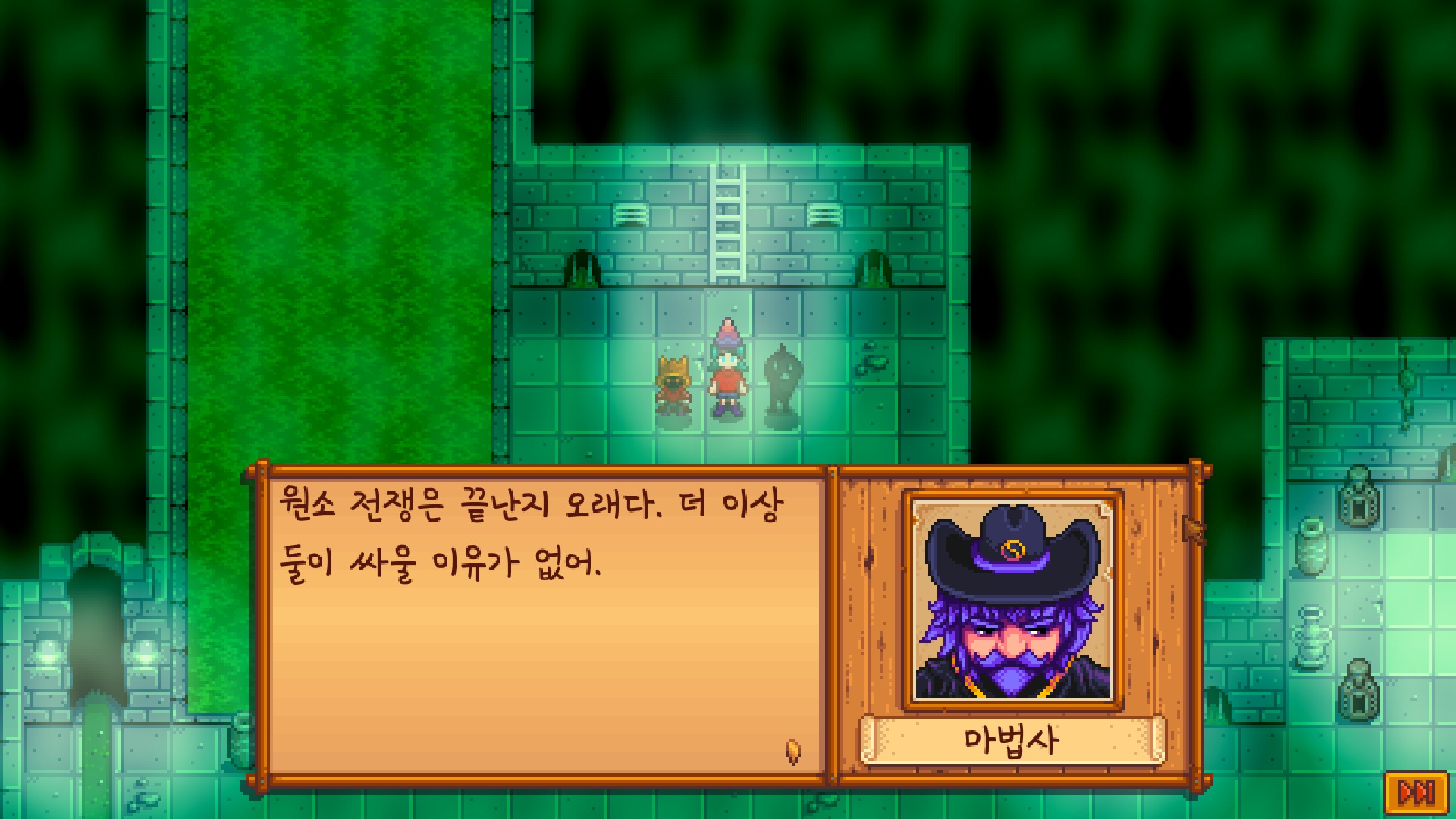 The Wizard separates an ended war from the present fight. Original Korean game screen shared by 라-루나. © ConcernedApe. Image source ↗
The terms that follow are concrete. The Dwarf agrees to stay away from the sewer. Krobus apologizes for the past and says he has no personal grievance with the Dwarf. The Wizard finalizes their agreement with a spell.
That is a workable peace without a declaration that the two now agree about history. The Dwarf’s promise concerns where to go; Krobus’s concerns how he regards this particular person. Neither statement restores the dead or resolves every dispute between their peoples.
Reading the ending as cautious coexistence fits those terms better than treating it as immediate friendship. The scene’s small achievement is that old losses no longer have to become another fight in this sewer. They can stop hurting each other before they have settled everything that hurt them.
Official sources
- Original English sewer encounter, recorded by Aarieth, the Gamer ↗Opening address uses Shadow Person; original game dialogue: about00:17 Krobus’s reply;01:04 Wizard;01:17–01:33 the agreement. Recording title is not used as trigger authority. Exact patch unverified.
- Original gameplay in Joey’s Quest’s1.6-labelled compilation ↗02:13–03:51 encounter;02:22.5 complete family accusation. Native dialogue separated from uploader description; exact patch not certified.
- Original Korean game screens shared by 라-루나 ↗Native Dwarf, Krobus and Wizard dialogue panes, including family accusation, displacement and ended war. Blog commentary is not official lore.
- Original volcano shop screen reproduced by PlayerAssist ↗DwarfShop_7.jpg shows a second merchant on floor5. Image is game material; the guide’s claims about total population are not adopted.