Mass Effect: Why Can Some Krogan Still Have Children?
Scope: Original English Mass Effect codex and the inspected Mass Effect 2 research-room conversation. Individual resistance, full egg/stillbirth physiology, later cures and exact recording patches remain outside this answer.
Spoilers Contains krogan population lore and Mordin’s account of his genophage work in Mass Effect 2.
The genophage makes krogan births desperately rare. Yet the games also speak of females who can bear children, and of clans fighting over them. If the weapon sterilized the entire species, how can both descriptions be true?
The original Mass Effect codex distinguishes fertility from offspring viability. The genophage sharply reduces the chance of a pregnancy reaching a successful birth; it does not make every krogan incapable of conceiving. That distinction answers the apparent contradiction, without explaining every detail of krogan reproduction.
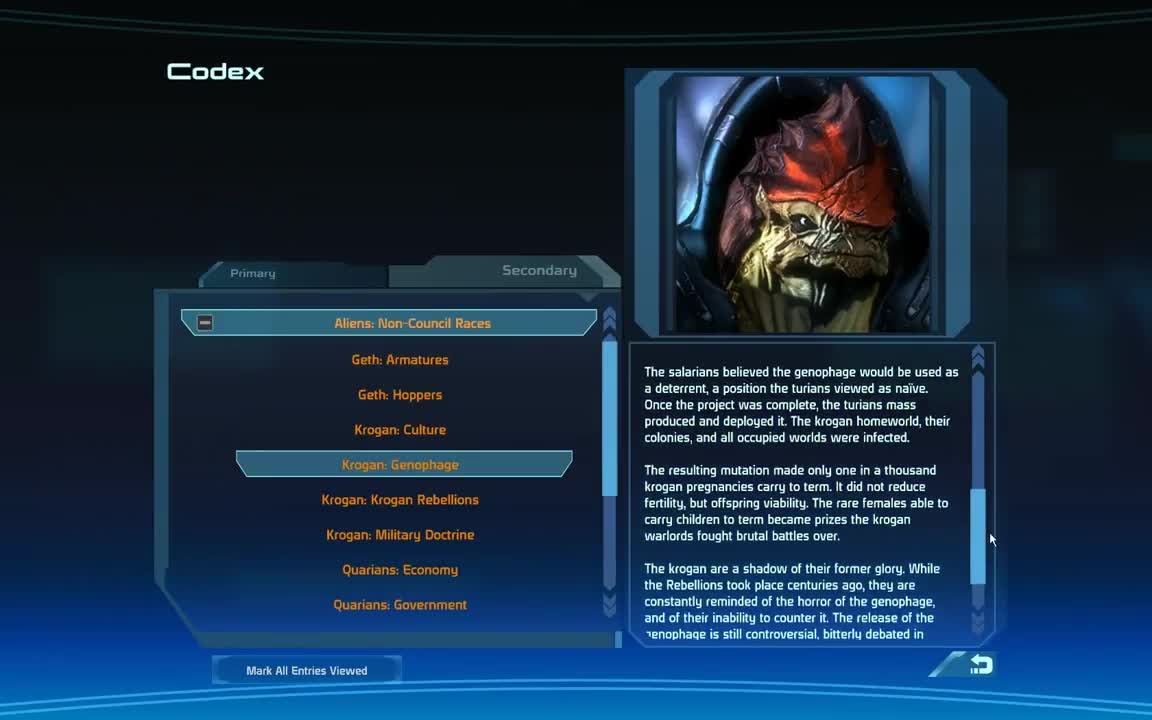 The same original entry mentions offspring viability and rare females able to carry children to term. Game capture from Zevik’s recording. © Electronic Arts/BioWare. Image source ↗
What “one in a thousand” counts
The primary krogan entry gives the rate as one viable pregnancy in a thousand. The secondary entry describes pregnancies reaching term and explicitly distinguishes fertility from the viability of offspring.
The denominator matters. This is not a statement that only one female in a thousand can become pregnant, with everyone else completely sterile. Nor does it give a schedule promising a particular mother one living child after a fixed number of attempts. A description of the weapon’s effect on the species is not an individual reproductive forecast.
“Fertile females” are not a later addition to this account
In the first game’s secondary genophage entry, the next sentence already discusses rare females able to carry children to term. Warlords fight brutal battles over them. Both ideas—the loss of offspring viability and the existence of these females—belong to the same original explanation.
Read “fertile” here in the context of successful births, rather than assuming it must mean an ability to conceive that every other female lacks. The description is concerned with who can bring living children into a population whose births have become scarce.
There is still a limit to that answer. These lines do not supply a model of individual resistance, prove that every successful mother is fully immune, or establish that every female has identical odds. Replacing the missing detail with a theory about luck or immunity would go beyond what this entry establishes.
Mordin’s modification is a separate event
During the inspected research-room conversation in Mass Effect 2, Mordin corrects the description of his work: he modified an existing genophage. He describes working within its constraints, rather than inventing the original weapon.
 Mordin distinguishes modifying the existing weapon from developing it. Game capture from jj0ck33’s recording. © Electronic Arts/BioWare. Image source ↗
In that exchange, he also says his team could have chosen to eradicate the krogan but did not. This is Mordin explaining his decision and its intended limit. It should not be confused with the original deployment—or treated as a verdict that the weapon caused no devastating harm.
The distinction is useful precisely because it leaves room for disagreement. Understanding what his work did does not require accepting his justification for doing it.
Surviving births do not make the damage disappear
The first game describes rare viable pregnancies alongside a declining krogan population. Its separate culture entry also describes fatalism and a loss of faith in the future as social consequences of the genophage. The harm reaches beyond a reproductive statistic.
Even the possibility of a living child changes how clans treat women who can bear one. A weapon aimed at reproduction reshapes relationships and the prospects for rebuilding a society.
The starting point is therefore narrower than “all krogan are sterile,” and more troubling than “some children still survive, so the weapon works harmlessly.” Births remain possible. Their scarcity is part of what makes the genophage so destructive. Whether its use or cure can be justified is a further argument; it should begin with the effect the codex actually describes.
This account uses inspected English material from the original Mass Effect and Mass Effect 2. It does not settle the full egg-versus-stillbirth physiology, later cures, or every individual case across the series.
This website is not endorsed by or affiliated with EA or its licensors.
Official sources
- Original Mass Effect codex, recorded by Zevik ↗06:05 primary Krogan;09:05 culture;09:15 secondary Krogan:Genophage. Actual game UI distinguished from uploader text. Exact patch unknown.
- Mordin’s research-room conversation, recorded by jj0ck33 ↗00:30 modification rather than development;00:50 choice against eradication. Actual English game subtitles; selected optional branch, not every route.
- Official publisher product and language listing ↗Publisher product title, BioWare/EA attribution and language table. Korean unsupported.
Further reading
- Unofficial Korean rendering check in 왓어쉐임’s gameplay ↗13:45 제노페이지;14:35 모딘;15:05 크로건. Fan-translated native subtitles, not official Korean localization. Used only for names, not as game1/2 lore evidence.