Primal zerg vs. the Swarm: what is actually different?
Scope: Heart of the Swarm campaign (Zerus and Korhal), checked against the official Story Primer. Later co-op descriptions and mechanics distinguished.
Spoilers Spoilers for Zerus, Dehaka’s alliance and the late Korhal mission “Death from Above”.
“Primal” makes the zerg of Zerus sound like an earlier, less developed version of the Swarm. That is a misleading starting point. They have kept changing, too. What they lack is the Swarm's hive mind.
Primal zerg evolve as individuals by taking essence; the Swarm coordinates its organisms through a shared psionic connection. Both can acquire useful traits. The difference is how individual growth, leadership and collective action fit together—not a simple ranking of old zerg against improved zerg.
Abathur catches the supposed ancestors copying him
On Zerus, Abathur discovers primal creatures based on the Swarm's hydralisk design. In the campaign conversation after “Waking the Ancient”, he complains that the newcomers' designs are already being replicated.
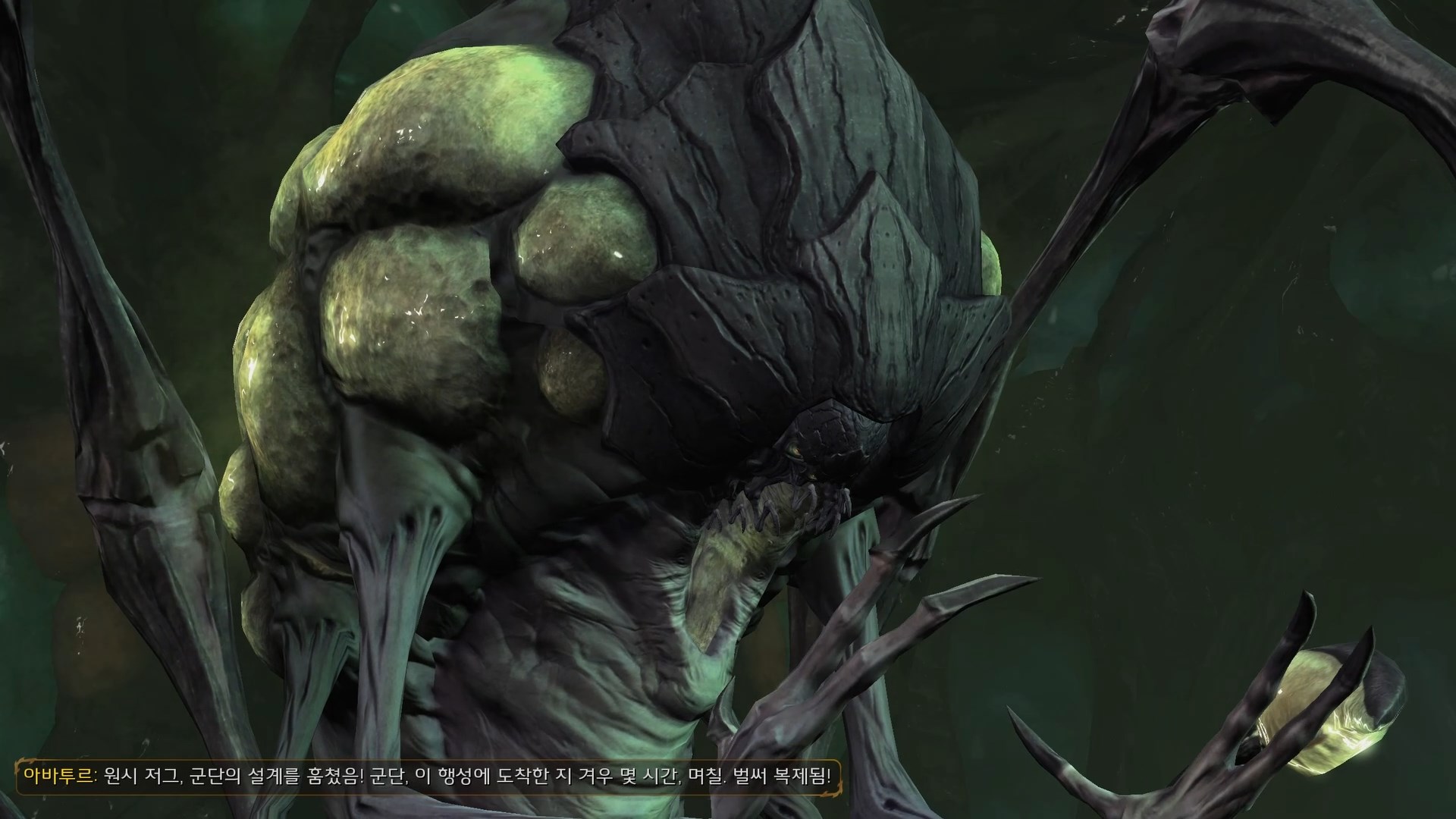 Abathur objects to primal copies of Swarm designs. Korean HotS campaign screen; game © Blizzard Entertainment. Screenshot: 옷게, 옷장 속 게이머 (unchanged; post license CC BY-NC-ND 4.0, linked in references). Image source ↗
That exchange rules out a tempting shortcut. A familiar-looking primal creature does not automatically establish the ancestry of a Swarm strain. In this case, the story gives the resemblance the opposite direction: the primals are taking from the visiting Swarm.
The primals are not frozen specimens of a distant past. Zerus is still a place where acquiring another creature's strengths changes the survivor. “Original” describes their relationship to the Swarm's imposed control more usefully than it describes an unchanged body plan.
The split was about control
The ancient primal Zurvan tells Kerrigan that Amon turned zerg into a weapon and took them away, while some escaped notice and remained. His later conversation about the hive mind identifies the crucial intervention: binding independent creatures to an overriding will.
This is the account given in Heart of the Swarm. Blizzard's later StarCraft Story Primer also places Amon's interference in the history of the zerg.
Evolution did not become exclusive to either branch. Blizzard describes Abathur as the Swarm's evolution master, working with new essences. The contrast is between a creature accumulating changes for itself and those useful traits being developed for a coordinated force. It should not become a claim that no individual Swarm organism can ever mutate.
The co-op commanders make the distinction playable in specific ways. Abathur's biomass system and Dehaka's essence collection are commander designs, not a complete set of biological laws for every campaign scene. Their numerical thresholds cannot settle a lore question by themselves.
Why does Dehaka follow anyone, then?
Independence does not prevent hierarchy. Blizzard's Dehaka commander preview describes primal packs led by strength while explicitly distinguishing them from hive-minded zerg. Following a pack leader does not require sharing a mind.
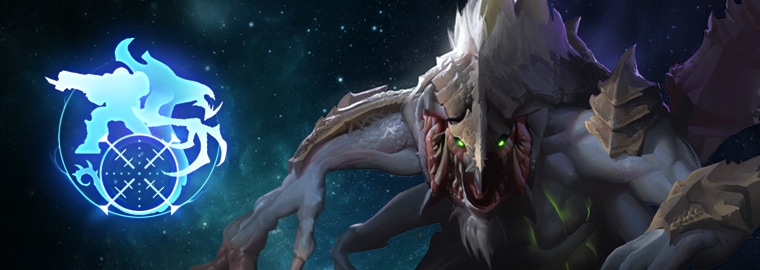 Official Dehaka co-op artwork, not a campaign screenshot. © Blizzard Entertainment. Image source ↗
Dehaka makes that distinction personal when he joins Kerrigan. In the “Supreme” shipboard dialogue, he offers to follow while she brings him more essence—and to stop if she does not. Kerrigan accepts the arrangement with a threat against betrayal.
This is an alliance whose terms can be spoken aloud. It does not require us to invent either hidden mind control or unconditional affection. Dehaka has a reason to accompany her. Fighting on the Swarm's side is not the same thing as becoming connected to its hive mind.
Korhal turns that distinction into a plan
The opening of “Death from Above” supplies the clearest practical test. Mengsk's Psi Destroyer attacks the Swarm through its shared connection. Dehaka lacks that connection, so his pack can reach the power links. Disabling them creates an opening for Kerrigan's main force.
The important limit is the weapon's mechanism. This scene does not establish immunity to every kind of psionic attack. Nor does it prove that primal zerg are universally stronger. It shows why a force outside the hive mind can do a job the connected Swarm cannot safely do while the field is active.
Dehaka remains useful to Kerrigan precisely because joining her has not erased the difference between them. The alliance gains something from the connection it does not have. For the other side of that problem—a leader trapped inside an imposed system—see why the Overmind created Kerrigan.
Official sources
- Patch 3.17 Preview: New Co-op Commander Dehaka ↗Design and playstyle: evolving packs without a hive mind. Co-op mechanics distinguished from campaign lore.
- Patch 3.3: Abathur is Coming to Co-op Missions ↗Swarm evolution master and essence. Biomass system is a co-op mechanic.
- StarCraft Story Primer ↗Later official overview of Amon and the zerg; Heart of the Swarm / Zerus.
Further reading
- Waking the Ancient — Zurvan and Abathur conversations ↗HotS campaign, about 17:09–17:40, 18:57–19:38 and 19:54–20:35. Third-party gameplay upload, not an official channel.
- Death from Above — Psi Destroyer briefing ↗HotS campaign, about 0:54–1:46 and 2:09–2:41. Third-party gameplay upload.
- Supreme — Leviathan scenes ↗Dehaka offers conditional following for essence. Fan-site dialogue record, not an official Blizzard article.
- [스타크래프트2 군단의 심장] 9-10. 거대괴수 ↗Korean campaign screenshot and dialogue. Third-party post, 2022-07-08; image reproduced unchanged with attribution.
- Screen capture post: CC BY-NC-ND 4.0 ↗Applies to the posting author’s contribution; does not transfer Blizzard’s underlying game rights.