SILENT HILL 2: Was Mary’s letter real?
Scope: The 2001 original’s English inventory, hotel scene and ending letter. Exact recording builds are unknown. Remake events, a definitive canon ending and the town’s complete supernatural mechanism are outside scope.
Spoilers Reveals the hotel letters, a major contradiction in James’s account and the final letter’s meaning. Read after finishing the original story.
Mary’s letter seems to give James a simple task: come to Silent Hill and find her. The final letter asks something much harder of him—carry on after her death. Both begin with the same words.
That resemblance is why “the letter was fake” needs a qualification. Mary writing a letter and James receiving the opening envelope are separate claims. The original game gives us reasons to accept the former without supplying a complete explanation of the latter.
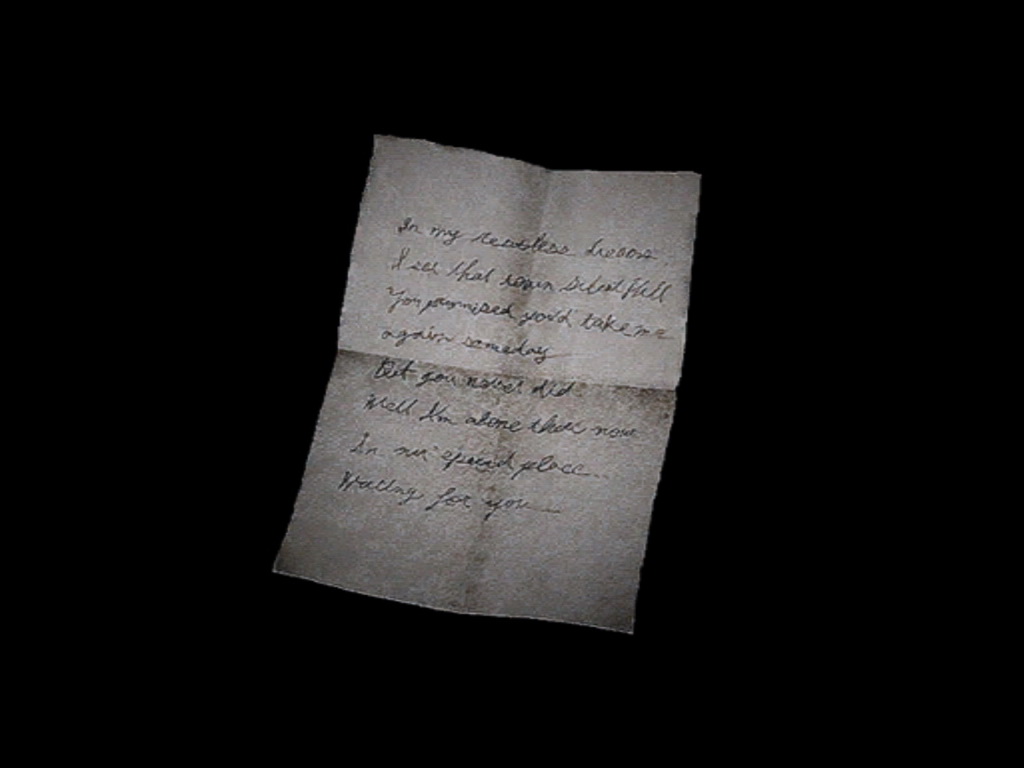 The letter James starts with. Original game screen, courtesy of Silent Hill Memories. © Konami Digital Entertainment. Image source ↗
Laura’s letter is addressed to Laura
At the hotel restaurant, Laura hands James a document with a different opening. Mary addresses Laura, says she is leaving the letter with their nurse for delivery after she is gone, and writes about their relationship. Laura says she took it from the nurse’s locker.
This is not another copy of James’s invitation. It asks Laura to give James a chance, expresses a wish to have adopted her, and wishes her a happy eighth birthday. When Laura says that birthday was last week, James questions his belief that Mary died three years ago. The original restaurant scene makes the document a challenge to his account, rather than independent confirmation that his wife is waiting nearby.
It also gives Mary a relationship that does not run entirely through James. Laura has her own reason to miss her. Treating every letter as James’s invention would erase the very distinction the scene makes: the invitation he brought and the document another person puts in his hands are not interchangeable evidence.
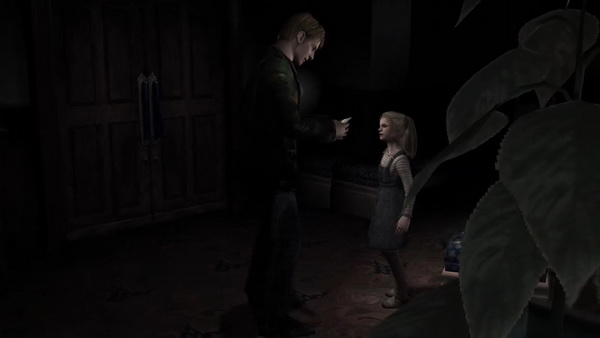 The hotel scene in which James reads Laura’s letter. Original game screen, courtesy of Silent Hill Memories. © Konami Digital Entertainment. Image source ↗
Read past the invitation
The letter narrated at the end repeats the opening’s promises and waiting. Then it continues into illness, loneliness, anger, affection and farewell. Crucially, Mary explains that she asked the nurse to deliver it after her death. By the time James reads it, she says, she will already be dead.
Those later lines in the original ending change what the opening can mean. A passage that sounded like directions to a living person belongs to a much longer goodbye. The invitation is no longer a sufficient account of what Mary is saying.
The shared wording also cuts against an overly simple answer. We cannot dismiss the opening sentences as something Mary never wrote: the full letter contains them. But matching sentences do not establish that the first envelope is the same physical object, or that it reached James through an ordinary delivery. Textual identity is not a chain of custody.
What the game leaves open
The original-game item index records the opening letter’s later examination states as blank stationery and then an empty envelope. That player-observation record supports doubt about treating the invitation as a stable piece of external evidence. It does not, on its own, explain how an object was created or what James had previously read.
There is another gap in the restaurant scene. Laura tries to show James a second letter, cannot find it, and leaves to look for it. Connecting that missing document with the final letter is a reasonable reading. The scene does not show the handoff, however, and failing to find it there does not prove it is lost forever.
A manifestation or a letter perceived through James’s delusion can explain the opening’s unreliability. Neither interpretation supplies every missing step. These scenes do not establish precisely how he knows the shared opening or how the first envelope came into his possession. The ending narration cannot settle those physical questions simply by existing.
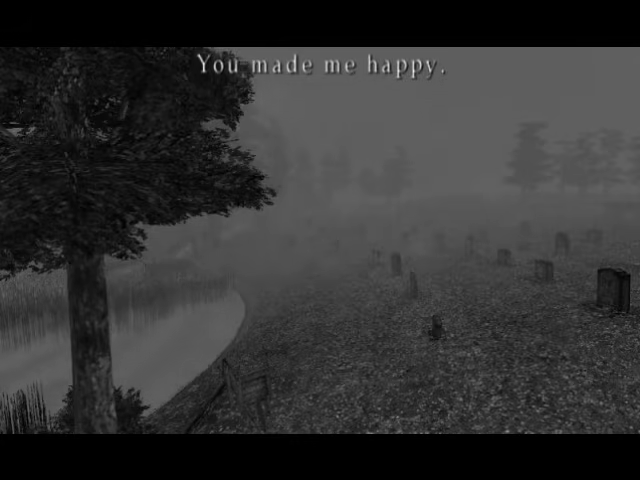 The letter’s closing line. Original game footage by Kyouka Sakurako,05:10. © Konami Digital Entertainment. Image source ↗
The distinction matters because doubt about the envelope need not swallow Mary’s goodbye. At first, James can hold on to a few lines that promise a reunion. At the end, the words continue beyond that promise, and Mary asks him to live for himself. The letter becomes more painful when it is allowed to finish.
Official sources
- SILENT HILL 2 — original inventory letters ↗Original game pixels hosted by Silent Hill Memories: the opening invitation and Laura’s letter. Surrounding fan transcription and interpretation are separate.
- SILENT HILL 2 — original hotel restaurant scene ↗AdamSpencer87’s PC original-game recording,01:54–03:51: letter handoff, birthday dialogue and the other letter. Uploader reports widescreen support; exact build unknown.
- SILENT HILL 2 — original final letter ↗Original English game text delivered by Kyouka Sakurako; opening,04:00–04:30 posthumous-delivery instructions, and05:10 closing line personally read. Exact port/build unknown.
Further reading
- Silent Hill Memories — original item index ↗Fan player-observation record for blank stationery and empty envelope; independently crosschecked against a 2003 player report. These states were not directly re-created or viewed as original inventory frames in this review; exact trigger timing is not asserted.
- Official PlayStation pages — title and Korean spellings ↗The current remake guide and Konami/Bloober’s PlayStation Blog supply Korean spellings only. Their remake events and ending rules are not imported into this original-game reading.