Why does Wheatley change after taking control?
Scope: Portal 2 released single-player: the chapter 5 takeover, chapter 8 testing, and the post-credits scene.
Spoilers Reveals Wheatley’s betrayal and his fate at the end of Portal 2.
Putting Wheatley in charge is supposed to be the way out. Instead, he starts asking why anyone needs to leave. Within moments, your ally is announcing that he is the boss.
Portal 2 gives us two pieces of the explanation. Wheatley enjoys his new power, and the body he occupies rewards him for testing. The first is a reading of his words and behavior during the takeover; the second is a mechanism GLaDOS explicitly describes. Keeping them separate helps explain his change without treating the chassis as a machine that makes every decision for him.
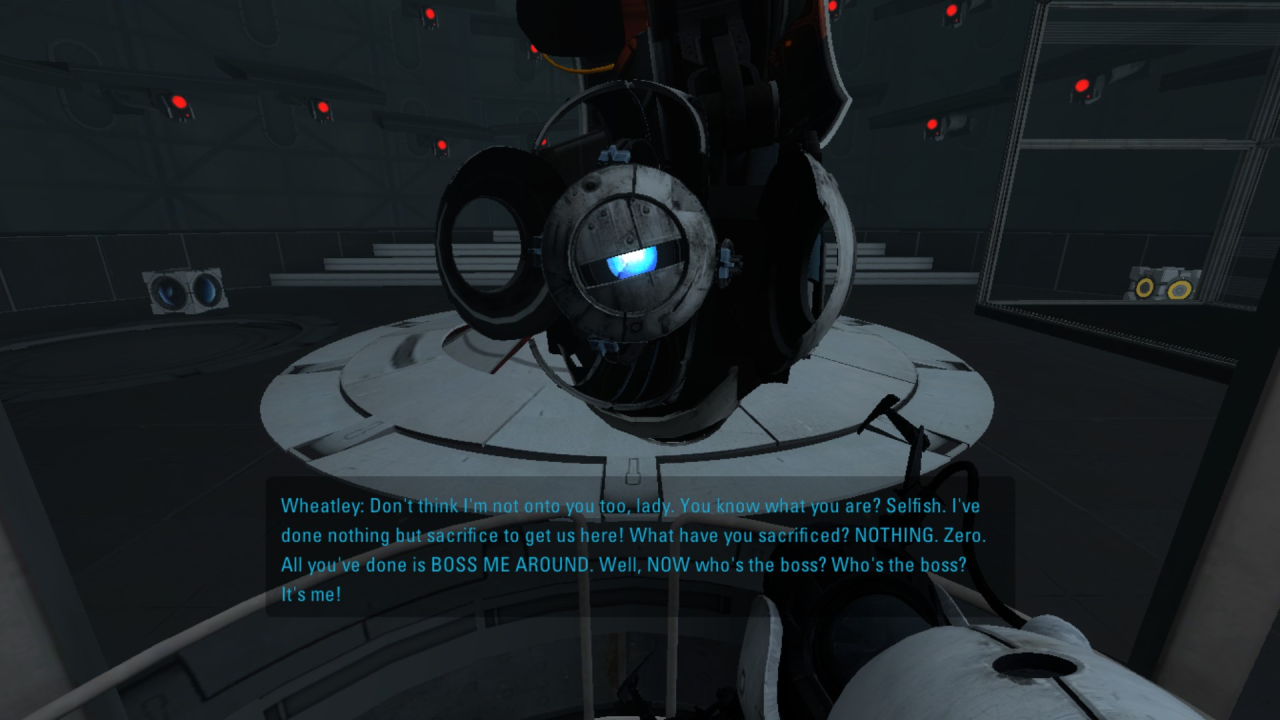 The takeover confrontation turns cooperation into a dispute over who gives the orders. © Valve Corporation · Portal Wiki / ChickenNuggetMan2056. Image source ↗

The escape becomes a dispute over credit
During the chapter 5 transfer sequence, Wheatley delights in the size and feeling of his new body. Then he questions the need to leave. His celebration turns into a claim that he alone made this possible, while Chell contributed nothing.
His accusation is revealing: she has spent their time together ordering him around. Now he can reverse that relationship. When he demands to know who the boss is, he is turning a shared escape into a hierarchy. Reading this as resentment mixed with a hunger for recognition makes sense of the confrontation. It remains an interpretation of what he says, rather than a personality diagnosis supplied by the game.
GLaDOS then identifies him as the core once attached to her to impair her thinking by feeding her terrible ideas. That is relevant to his judgment. It does not establish a secret plan to betray Chell from the beginning. A design that produces bad ideas is not, by itself, evidence of a particular intention.
Testing comes with a reward—and a problem
In chapter 8, GLaDOS offers a more specific explanation. Speaking from the potato attached to the player's portal device, she describes a response built into her former body: testing produces euphoria. Resistance develops, and the resulting difficulty can become unbearable without the capacity to work through it.
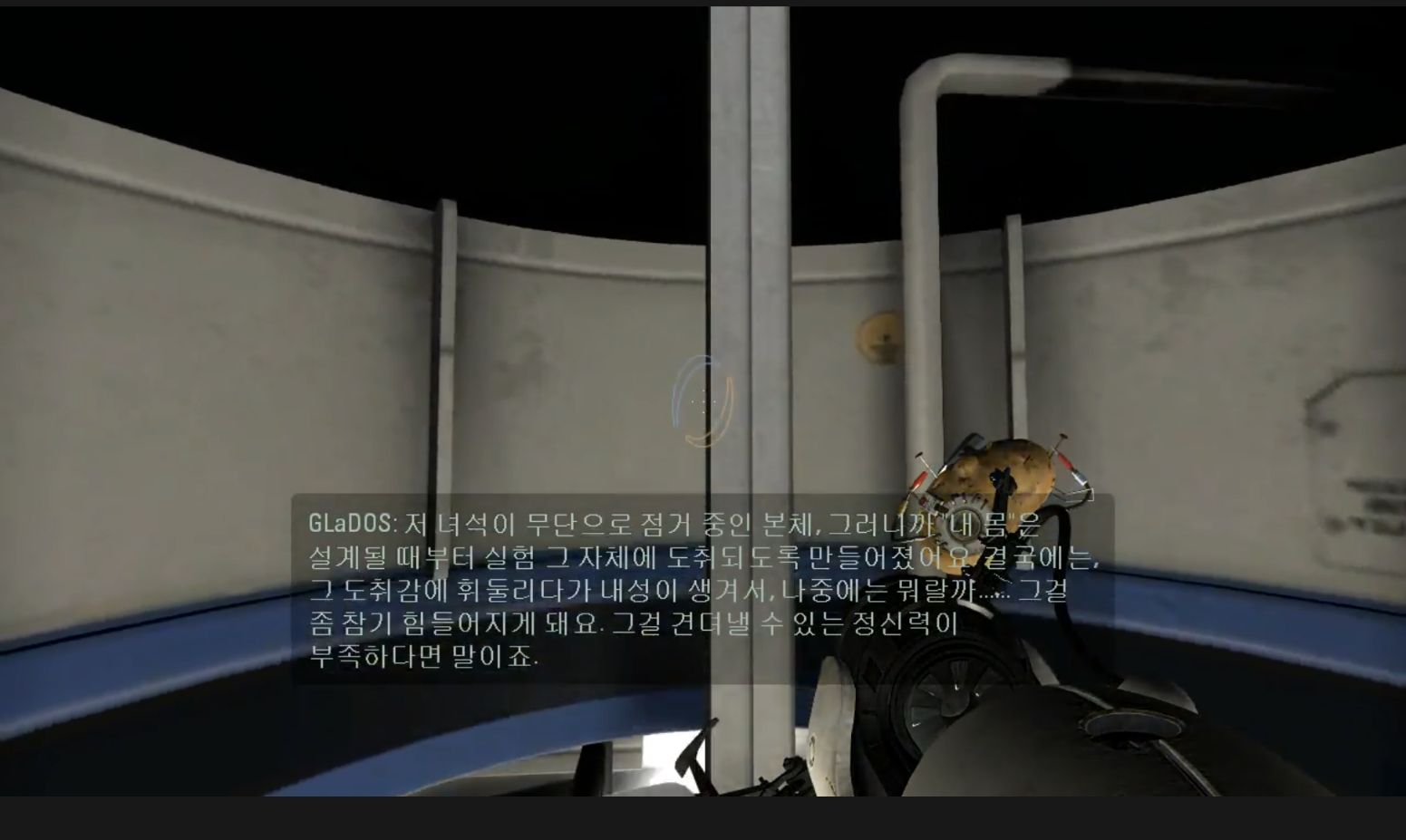 GLaDOS describes a built-in response to testing and the resistance that develops. The paragraph above paraphrases the Korean subtitle. © Valve Corporation · KOZAK9u. Image source ↗
Shortly afterward, Wheatley says he is moving the test chambers closer in case that helps the results. In this context, the change looks less like sound facility management than an attempt to recover the feeling he wants. The built-in reward gives his fixation on testing a concrete cause.
GLaDOS also says the problem mattered little to her because she was absorbed in the science. Her account of her own superiority need not be accepted without question. Still, the distinction in her explanation matters: experiencing the response and coping with it are different things. She does not describe a mechanism that forces every occupant to make identical choices.
This is why the reward system explains more than “power went to his head,” but less than a complete erasure of Wheatley's agency. It directly addresses his need to test. His accusations against Chell, his insistence on credit, and his delight in being in charge remain part of the story too.
An apology after the power is gone
In the post-credits scene, Wheatley is floating in space, separated from the body. He imagines seeing Chell again and apologizing for how domineering and monstrous he was. The moment complicates a reading in which he was simply, permanently evil all along.
It is not a controlled demonstration that disconnecting the chassis restores an original personality, either. He has also lost his power and lived through the catastrophe he helped create. The ending shows regret; it does not isolate a single technical cause for that regret.
The most convincing reading holds the two pressures together: Wheatley gains the power to impose himself on others, then becomes caught up in the body's reward for testing. The mechanism is explicit. The desire for recognition is visible in how he frames his conflict with Chell. Neither makes the other irrelevant.
At the takeover, he wants the final word because he is the boss. At the end, the words he wishes he could deliver are an apology. That change is what makes him more than a faulty component swapped into the wrong socket.
Further reading
- Portal 2 — chapter 5 core transfer ↗18:46–20:16. Original Korean game subtitles in KOZAK9u’s footage; body celebration, credit dispute, and GLaDOS’s account of Wheatley’s design. English prose paraphrases these subtitles.
- Portal 2 — chapter 8 testing response ↗11:42–11:47, GLaDOS speaks in the elevator after chamber 5; 12:12, Wheatley moves chambers closer. Original Korean subtitles, paraphrased in English. KOZAK9u footage.
- Portal 2 — post-credits apology ↗22:49–22:59, Wheatley in space. Original Korean game subtitles in KOZAK9u’s footage, paraphrased in English.