Could Portal 2’s fall-protection boots work in real life?
Scope: Valve’s 2011 Boots promotional film and announcement, with separately labelled idealized Earth-physics analysis. No measured game fall, hidden mechanism or injury threshold.
Spoilers Equipment and promotional imagery; no story-ending spoilers.
A spring heel looks like a reassuring explanation for Portal 2’s enormous falls. The boot flexes, the wearer lands, and the experiment continues. Could a real version do the same?
A real device can soften a landing, but a short, strong spring does not make a long fall harmless. It still has to stop the whole body over enough distance, manage the force transmitted to it, and deal with the energy stored during impact.
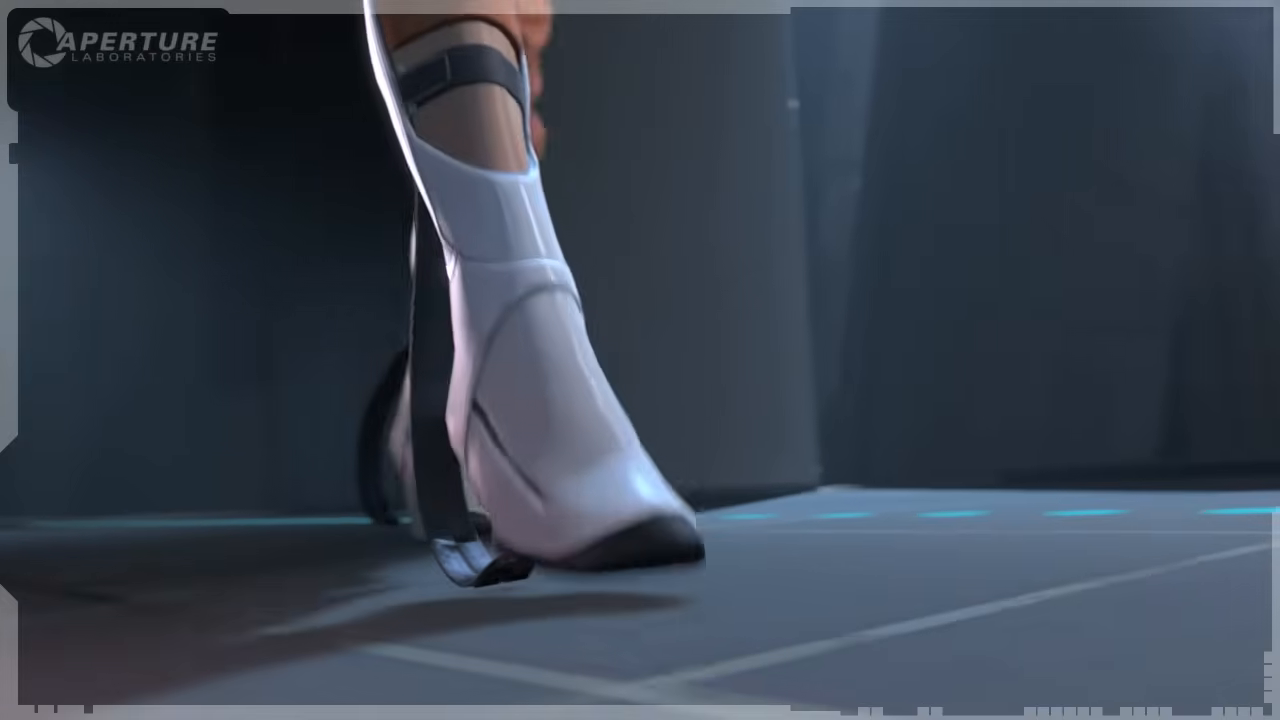 Curved rear supports in Valve’s official Boots film, 0:41. © Valve. Image source ↗
What Valve actually demonstrates
Valve’s April 12, 2011 announcement calls the device the Long Fall Boot. Its linked promotional film shows the curved rear supports and then a falling wearer landing on both feet.
That establishes the fictional product’s advertised performance. It does not provide a specification for its internal damping, its load path through the body, or its stopping distance. We can inspect the demonstration without treating its appearance as an engineering blueprint.
Landing feet first also leaves a second problem to solve. Once the feet meet the floor, the rest of the body is still moving downward. Even an unbreakable boot would have to apply force to bring it to rest. Correct orientation and gentle deceleration are separate requirements.
Give the body more room to stop
Consider a deliberately hypothetical fall: a 60kg mass drops 10m from rest under Earth gravity, ignoring air resistance. With gravitational acceleration of 9.8m/s², it reaches about 14m/s and carries about 5,880 joules of kinetic energy. These are applications of gravitational potential and kinetic energy, not measurements of a game character or a particular scene.
The work–energy theorem makes the next step revealing: removing that kinetic energy over a shorter distance requires a larger average braking force.
During a vertical landing, gravity keeps pulling downward too. Including it gives an upward contact force, averaged over the stopping distance, of mg + mgh/d. Here h is the drop height and d is the additional downward travel of the body’s center of mass while stopping. That travel is not necessarily the visible flex of a heel support.
| Center-of-mass stopping distance | Average upward contact force | Multiple of the ordinary weight-support force |
|---|---|---|
| 5cm | About 118,000N | About 201 times |
| 50cm | About 12,300N | About 21 times |
| 1m | About 6,470N | About 11 times |
Increasing the stopping distance tenfold reduces the braking contribution tenfold. Simply using stronger material does not have that effect. It might keep the device intact while leaving the wearer exposed to a very large load.
This model treats the body as one mass. It does not calculate peak force, joint loading, or injury. Nor does the one-meter row identify a safe landing. The comparison isolates one issue: how much room the body has to lose its speed.
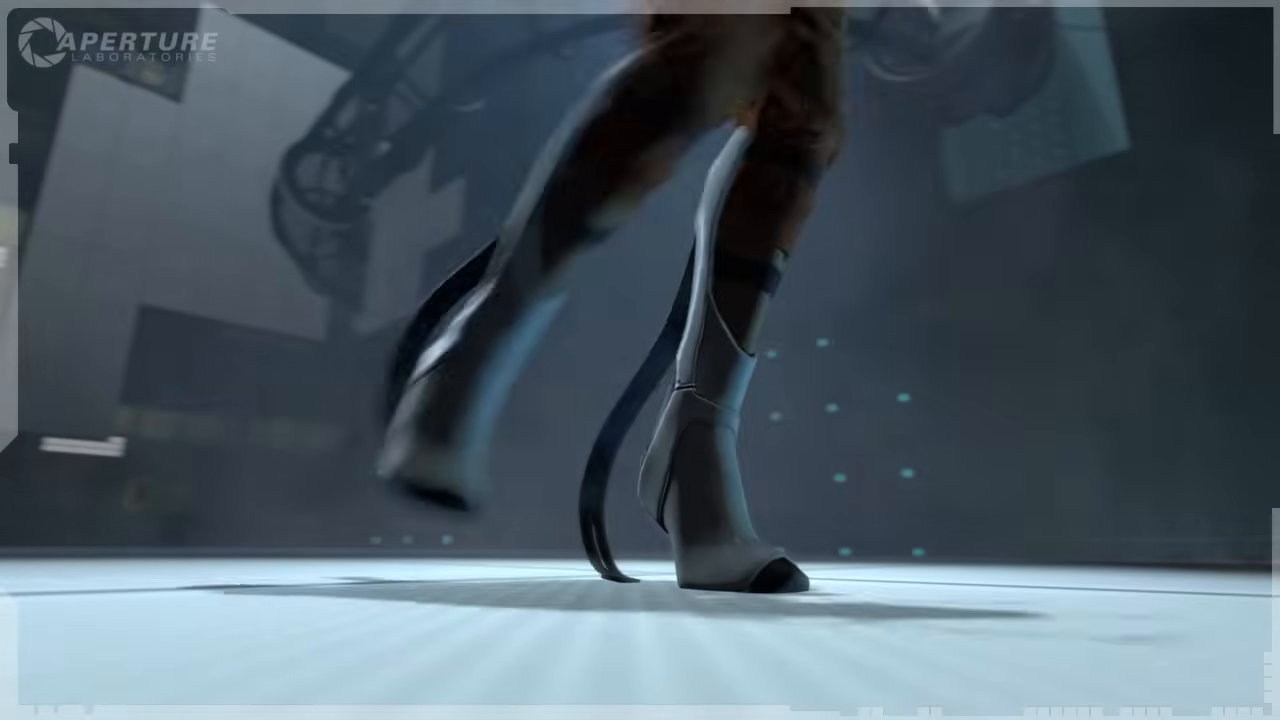 Feet-first contact in the official promotional demonstration, 0:55. © Valve. Image source ↗
A spring stores the fall
The curved support suggests elasticity, and elasticity can help accept energy during a landing. But an ideal spring stores energy and returns it. Compression alone does not erase the fall; extension can launch the body again.
A controlled landing therefore needs a way to dissipate energy or govern its release, alongside the spring’s ability to accept it. Damping might turn energy into heat, for example. Even then, it cannot remove the force required to stop a body over a very short distance. Energy disposal and deceleration distance solve different parts of the problem.
An extraordinary mechanism could be imagined inside the fictional boot. The inspected announcement and film do not establish one. Assigning it a secret energy sink would be a proposed explanation, not a verified piece of Portal lore.
The missing part is bigger than a heel
To pursue similar performance in reality, a design would have to address the incoming speed, available stopping travel, and distribution of force through the body. Reducing speed by half reduces kinetic energy to a quarter. Slowing the fall before touchdown changes the task the landing device must perform.
Portal 2 packages protection into a beautifully small prop. Real elasticity and damping explain why its silhouette feels plausible. They do not, by themselves, validate the effortless landing shown in the film. The useful question is not just whether the heel could survive: it is where the moving body gets room to stop, and where its energy goes afterward.
For another boundary between a physical explanation and a fictional rule, see what moon rock does—and does not—establish about portal surfaces.
Official sources
- Valve — Boots promotional film ↗0:41 rear supports; 0:55 feet-first landing.
- Valve — April 12, 2011 boot announcement ↗Long Fall Boot
Specialist sources
- OpenStax — work and energy ↗Physical principles used for an independent hypothetical calculation; no source diagrams or examples reproduced.
- OpenStax — stopping force ↗Physical principles used for an independent hypothetical calculation; no source diagrams or examples reproduced.
- OpenStax — spring potential energy ↗Physical principles used for an independent hypothetical calculation; no source diagrams or examples reproduced.