Why does GLaDOS let Chell go after deleting Caroline?
Scope: The released Portal 2 single-player ending. Unused dialogue, actor interpretation, fan theories and the co-op campaign's later state are outside the conclusion.
Spoilers Full spoilers for Portal 2's final battle and ending.
After announcing Caroline's deletion, GLaDOS sends Chell to the surface. Removing the human presence inside her does not lead to another execution attempt. Why let her old enemy leave?
GLaDOS offers a practical answer: killing Chell is difficult, and the easiest solution is usually the best one. That is her stated reason for ending their conflict. It does not establish that she has no affection left, or explain every part of the rescue that came before it.
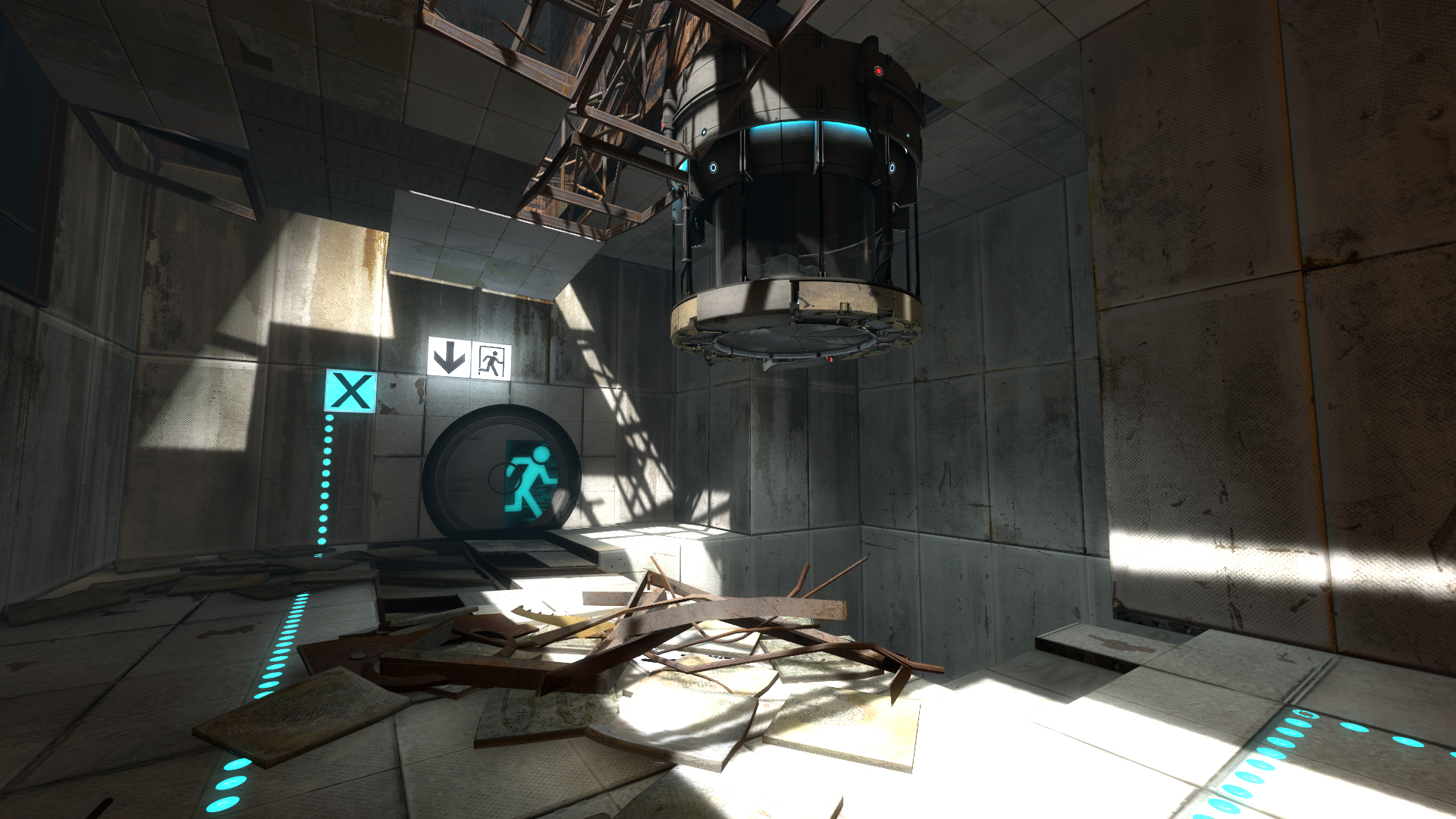
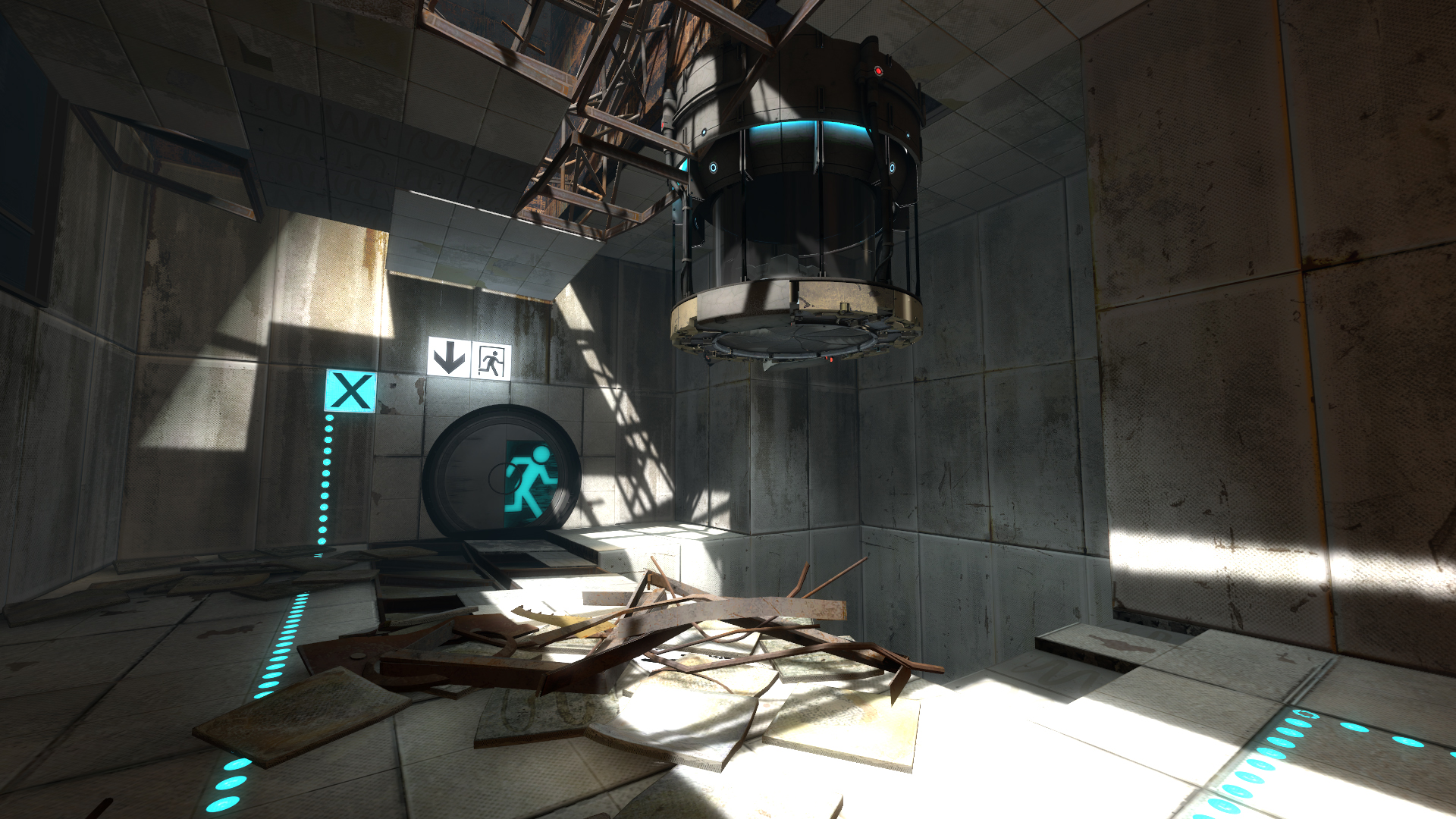 GLaDOS describes wanting her life of testing back. Official chamber screenshot, not the ending scene. © Valve Corporation. Image source ↗
What GLaDOS actually explains
The ending speech moves from relief to rejection. GLaDOS says that the emotion she felt when saving Chell revealed where Caroline lived in her brain. She says goodbye, the facility announces the deletion, and she turns to the easiest way of solving her problem.
She admits that killing Chell is hard. Her complaint then becomes almost domestic: she used to test in peace, without being killed or put in a potato. Finally, she concedes that Chell wins and tells her to leave.
Read on its own terms, this is a decision to stop pursuing a conflict, rather than a declaration of forgiveness. GLaDOS does not claim to have become good. She presents Chell's departure as the simpler choice. Calling it a calculated eviction is an interpretation of that speech, not a complete account of her private motives.
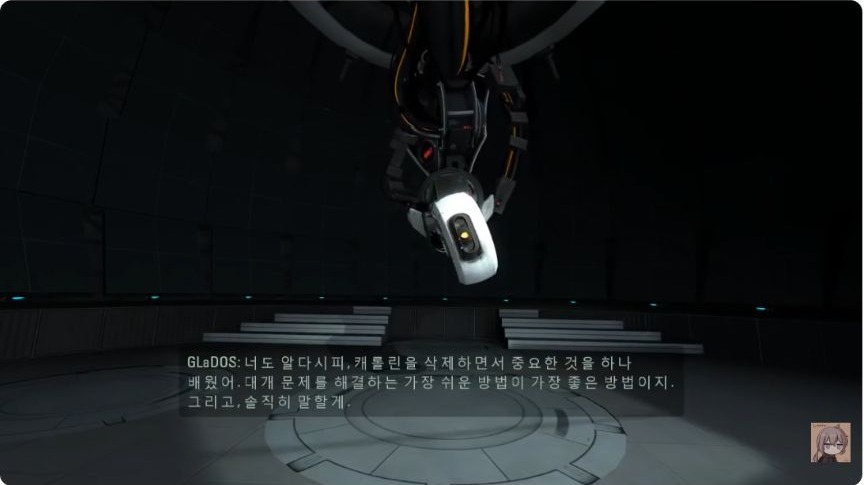 The Korean subtitle introduces the easiest solution. The admission that killing is hard comes afterward and is not shown in this still. © Valve Corporation. Image source ↗
The earlier rescue leaves room for emotion
Before this conversation, the portal to the Moon pulls Chell into space. GLaDOS, back in her body, grabs her and pulls her inside. The deletion exchange happens after Chell wakes up. The released ending therefore distinguishes saving her life from subsequently letting her leave Aperture.
This matters because the practical explanation belongs to the later release. Using it as the sole explanation for the rescue would overlook GLaDOS's own account of feeling a surge of emotion. Conversely, that emotion does not prove that Caroline took control and forced the rescue. The dialogue identifies a connection; it does not specify who controlled the decision.
The sequence is useful context, but it does not settle the emotional question. GLaDOS could have more than one motive, and the reason she chooses to say aloud need not exhaust them.
A deletion announcement is not a map of her mind
The facility reports Caroline's deletion. What it does not explain is exactly which memories or feelings have been removed. Taking the announcement seriously does not require treating it as proof that every trace of Caroline is gone.
Existing discussions of Caroline's fate already explore literal deletion, partial removal and deception. The singing turrets on Chell's way out can support an affectionate reading of the farewell. They cannot demonstrate how the deletion worked, or prove that it failed.
The answer is clearest when its limits stay visible: GLaDOS says that letting Chell go ends a problem she is tired of trying to solve by killing her. Whether affection also lies behind that decision remains open. The ending gives us a reason she states, not a complete inventory of what she still feels.
Further reading
- Released Portal 2 ending — English ↗0:07–1:10, released ending sequence after the rescue: Caroline deletion and release. Third-party footage.
- Released Portal 2 ending — Korean subtitles ↗6:10-6:56, independently checked localization and scene order.
- Official Portal 2 overview ↗Valve's official game, GLaDOS and Aperture Laboratories description.
- Arqade — What is Caroline's fate? ↗Existing answers and competing interpretations; kept separate from released-game evidence.