ELDEN RING: Is Melina the Gloam-Eyed Queen?
Scope: The inspected base-game ending and purpose dialogue, queen/black flame item descriptions, and expansion kindling text. Exact recording patches and a complete dialogue survey are unverified.
Spoilers Full base-game ending spoilers, Melina’s changed eye, and the expansion’s Messmer kindling description.
Melina ends her final vow with two words: “Destined Death.” With her previously closed eye now glowing purple, it is easy to hear that line as the revelation of another name—the Gloam-Eyed Queen.
The connection has substance. The identification remains a theory. The ending gives Melina an unmistakable association with death, but a promise to deliver death does not, by itself, tell us who she used to be or whose power she has inherited.
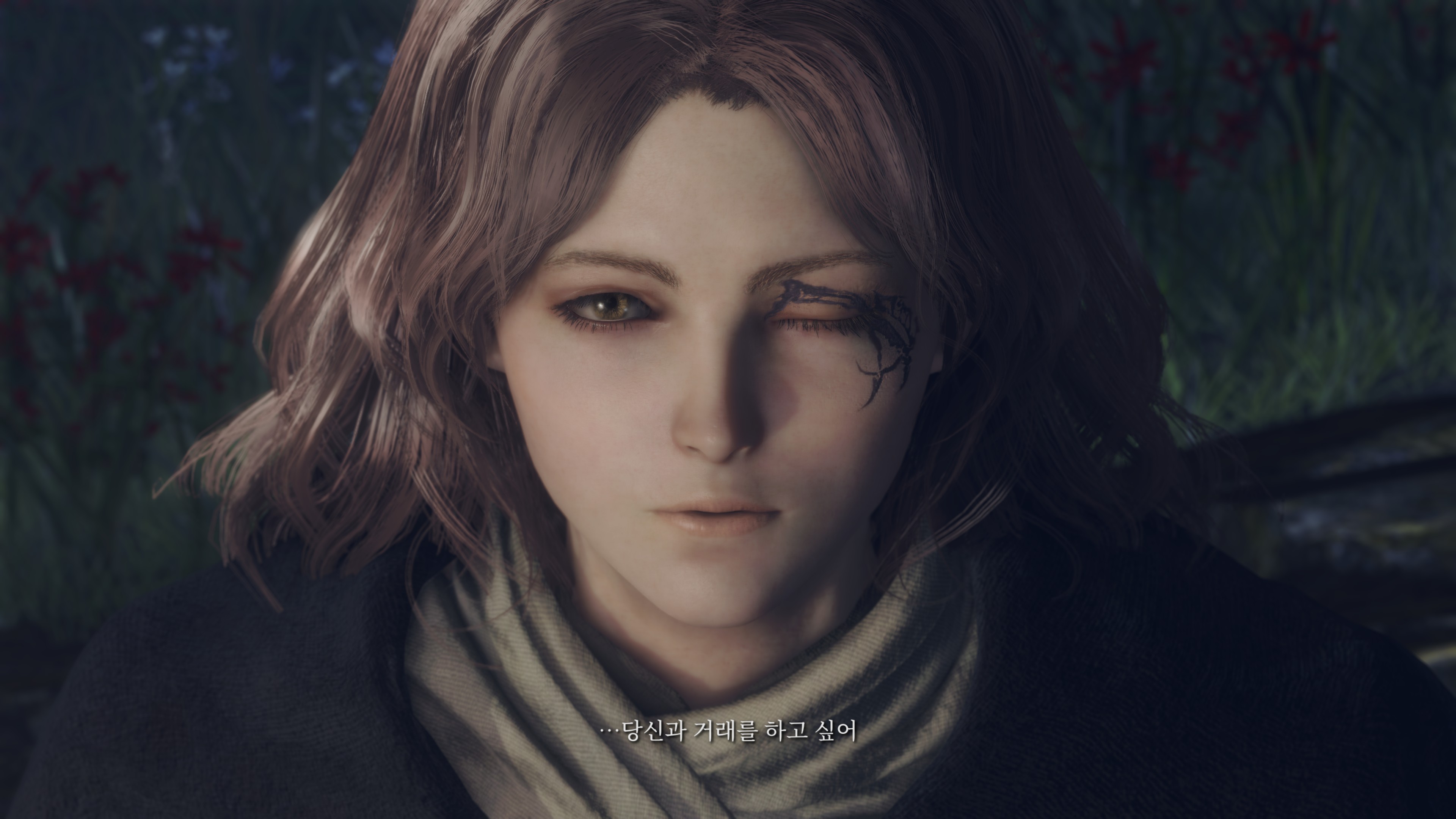 The closed left eye at the first meeting. Original game screen shared by 나의기록일지. © Bandai Namco Entertainment / FromSoftware. Image source ↗
What the eye scene actually reveals
In the final scene with Melina still alive, after the world has been engulfed in chaotic flame, she promises to seek the addressee and deliver what is theirs. Her left eye is open and purple; the other appears pale. Destined Death is the last thing she names.
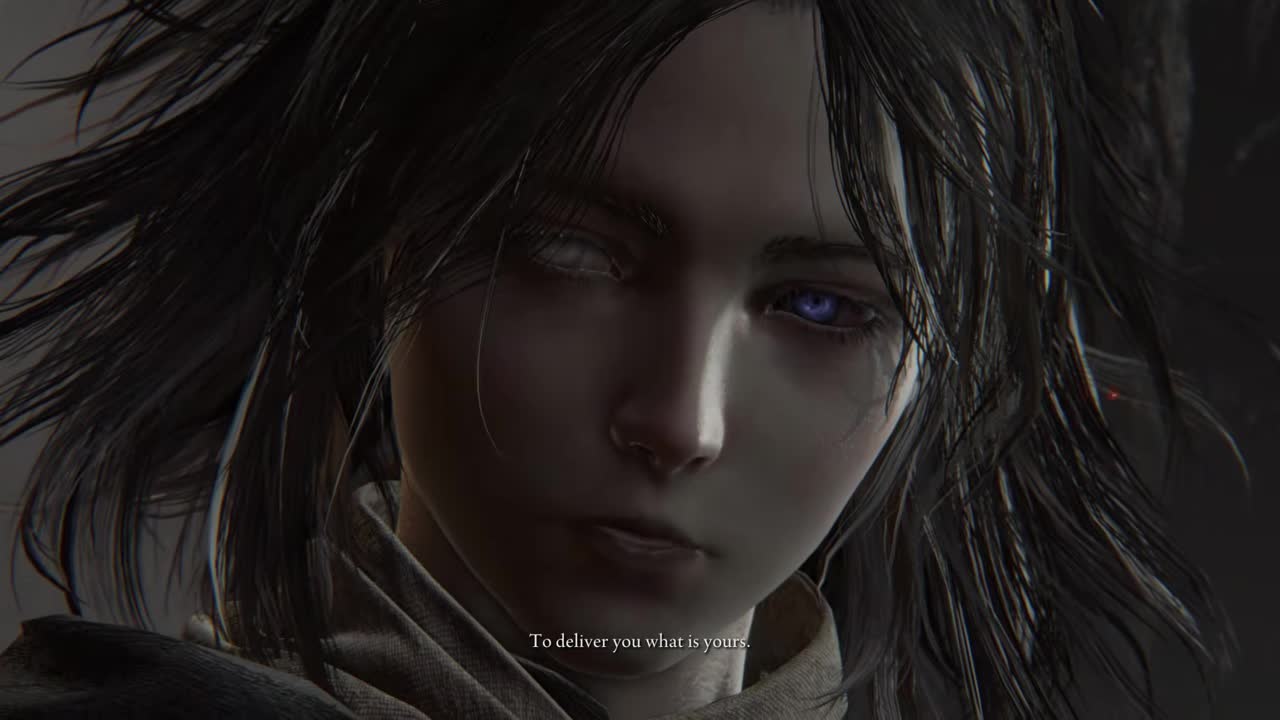 The opened left eye and final vow. From Games from Mars’s original game recording. © Bandai Namco Entertainment / FromSoftware. Image source ↗
That is enough to make the eye significant. It is not an explanation of a transfer of power. The scene names no former owner, depicts no inheritance, and does not call Melina the queen. Saying that she inherits the queen’s power supplies an event that the scene itself does not describe. Saying that she is the queen supplies an identity it does not state.
Neither interpretation is disproved by that distinction. They need support beyond the promise.
Why the queen is a serious candidate
The Godslayer’s Greatsword description identifies its former queen as the leader of the Godskin Apostles, defeated by Maliketh. It also traces the apostles’ black flames to the sword. A black flame incantation explains that the flame lost its former power when Maliketh sealed Destined Death. The original Korean inventory screens preserve this distinction between the queen’s defeat and the sealing of death.
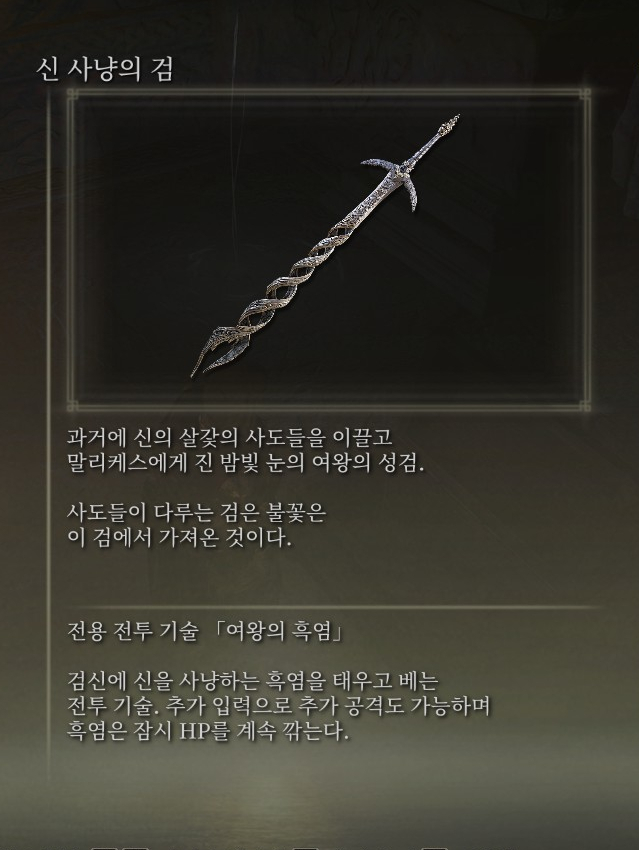 The sword records the queen’s defeat and the apostles’ black flames. Korean game item screen shared by qdo3obp. © Bandai Namco Entertainment / FromSoftware. Image source ↗
Melina’s purple eye therefore does not stand alone. The queen’s epithet, the god-slaying flames and the ending’s death vow give the theory a connected set of clues. What they establish is an association. They do not yet distinguish the queen herself from someone linked to the same power.
Melina’s account of being burned and bodiless does not close that gap. In the same conversation she recalls a purpose given by her mother inside the Erdtree. She does not identify the person who burned her or say that this happened in a battle with Maliketh. Likewise, the sword records the queen’s defeat, not a death and return under Melina’s name.
The early English sword screen linked above calls her the Dusk-Eyed Queen; the original Godskin Swaddling Cloth description reproduced here uses Gloam-Eyed Queen. The connection to Melina rests on the recorded deeds and death imagery, rather than treating an epithet as a personal name.
The sister clue adds a relationship, not a verdict
The expansion’s Messmer’s Kindling description compares Messmer’s vision of fire with his younger sister’s. Melina’s role as kindling makes her a plausible reading of that sister. This adds a family connection to consider rather than erasing the earlier death imagery.
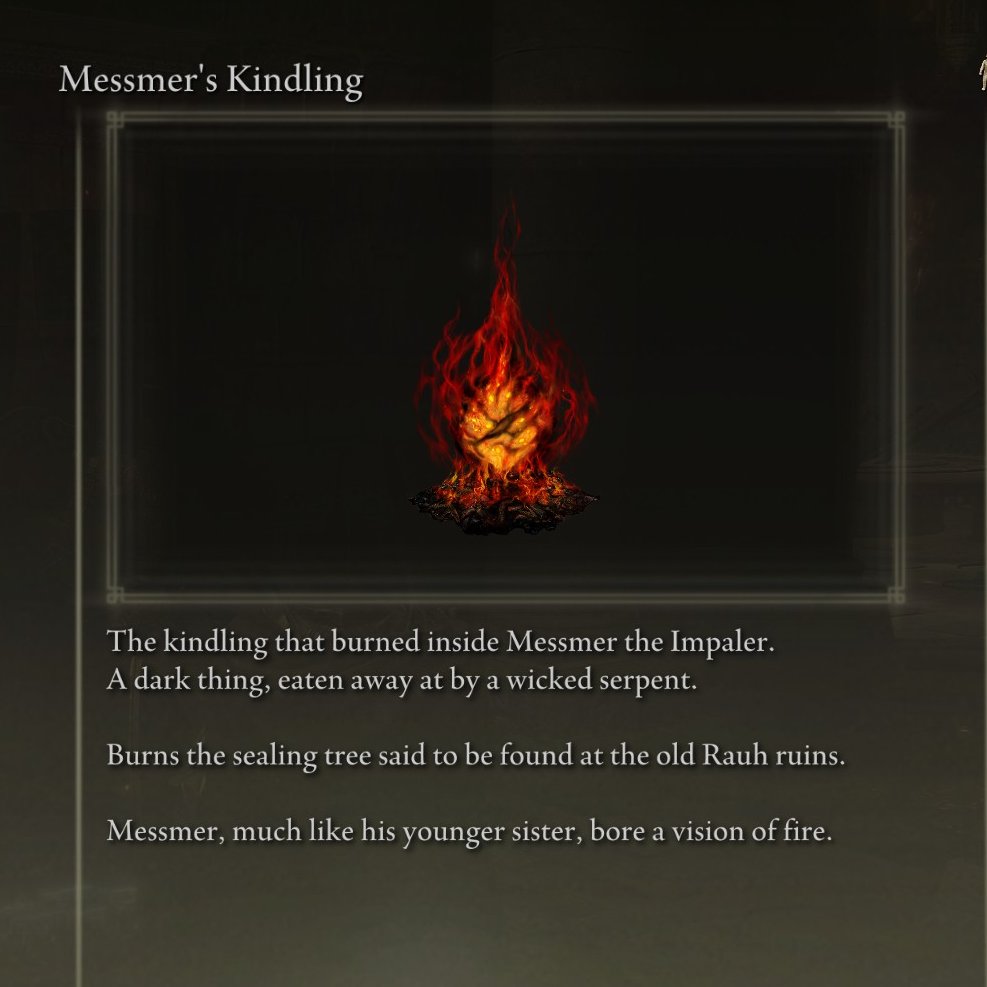 The younger sister is mentioned without a name. Original English game screen shared by HkonMk. © Bandai Namco Entertainment / FromSoftware. Image source ↗
The item screen does not name the sister. Even accepting her as Melina would not automatically confirm or refute the queen theory. To make the family clue decisive, we would also need a chronology connecting the queen’s defeat with Melina’s birth and burning. That chronology is not supplied by this description.
The inspected evidence leaves Melina as a compelling candidate, with her former identity unresolved. What is missing is not another resemblance. It is a direct link between the queen’s recorded past and Melina’s own.
For the separate question of what releasing death changes, see why setting the Erdtree alight is only part of opening its entrance.
Official sources
- Original ending, recorded by Games from Mars ↗00:44–00:58 native ending subtitles and opened-eye scene. Game authorship separated from recording delivery. Exact patch unknown.
- Melina’s purpose dialogue, recorded by TheFinalEpic ↗05:55–06:00 actual native English dialogue; mother inside Erdtree and burned/bodiless. Not a named assailant or chronology.
- Original Korean sword screen shared by qdo3obp ↗Original Korean item description; blogger commentary is not adopted as game text.
- Original Korean black flame item screens shared by intensity ↗Images47/48 original Scouring Black Flame and Black Flame Ritual item panes. Early Korean rank word not silently modernized.
- Original Messmer’s Kindling screen shared by HkonMk ↗Actual item UI screenshot, not poster speculation. Younger sister not named. Exact patch unknown.
- Original English sword and cloth wording, delivered by PC Gamer and GameRant ↗Native sword screen says Dusk-Eyed Queen. Native cloth pane at https://gamerant.com/elden-ring-where-get-godskin-swaddling-cloth-talisman-location/ says Gloam-Eyed Queen. No patch chronology asserted.