Why did Marika shatter the Elden Ring?
Scope: Released ELDEN RING base-game hammer description and Melina echoes, checked against publisher story introductions (2021 and 2026). No exhaustive DLC theory, assassination authorship, exact plan date or single confirmed end goal.
Spoilers Major base-game story spoilers for Godwyn's death, Marika's act and her connection with Radagon.
Godwyn's death is the strongest stated catalyst for Marika's shattering of the Elden Ring. It is not, however, a complete account of her intentions. The game also preserves an older promise to bring exiled warriors back—and carefully distinguishes her destruction of the Ring from Radagon's attempt to repair it.
That leaves a more interesting question than whether Marika was grieving or making plans: what had she actually planned, and which parts of the catastrophe are we adding to that plan ourselves?
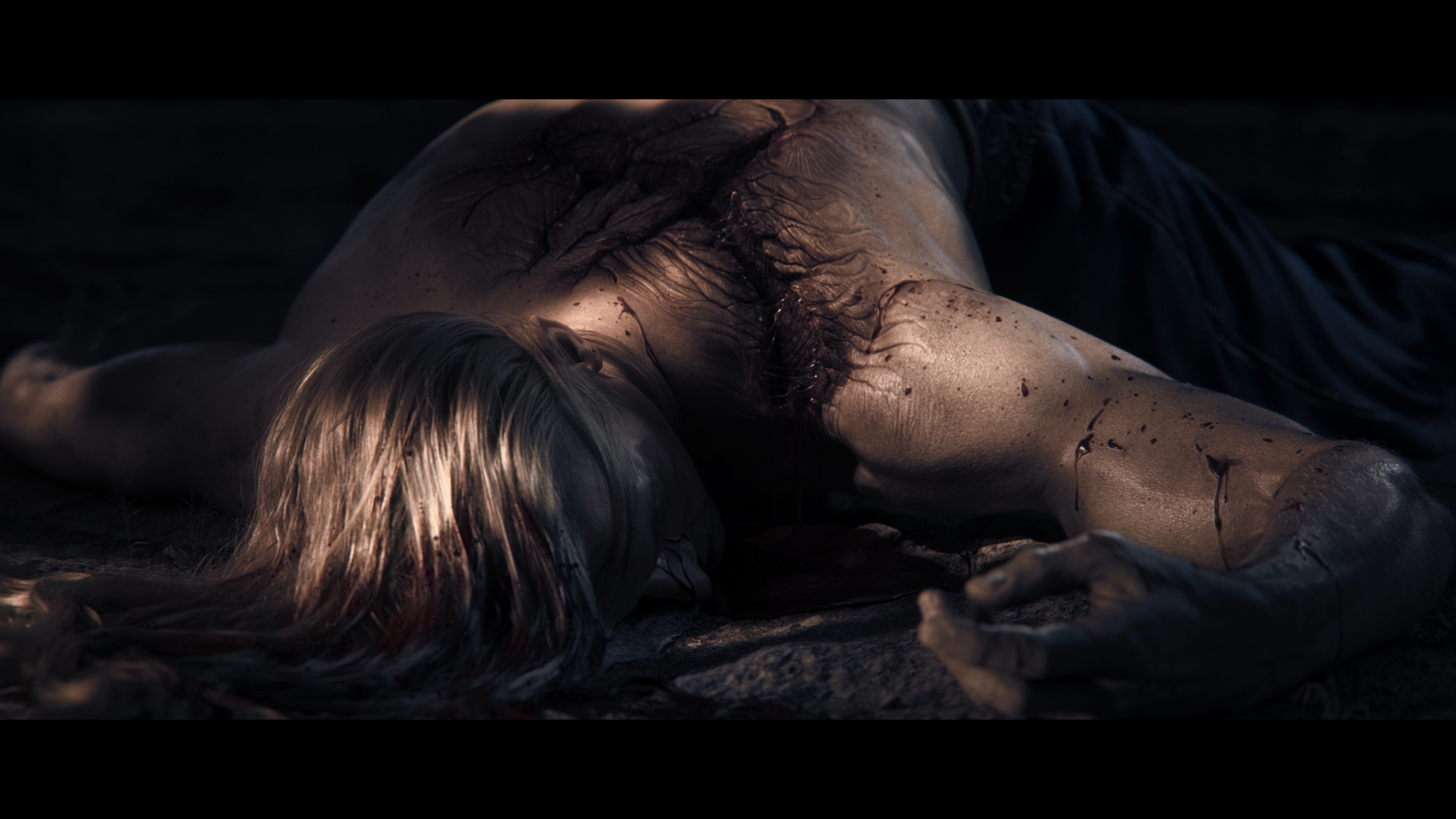 Godwyn in the official story trailer. Still from Bandai Namco's press kit. © Bandai Namco Entertainment / FromSoftware. Image source ↗
Grief has evidence behind it
Bandai Namco's Age of Gods introduction singles out Godwyn's death as an especially devastating loss for the queen, then connects it to the breaking of the Ring. The accompanying trailer describes Marika being driven to the brink. An official 2026 introduction to the game also places her act of shattering after the assassination.
This is substantial support for reading the murder as a catalyst. Dismissing grief altogether loses something the official presentation deliberately emphasizes.
But a catalyst is not a complete motive. These introductions do not give us Marika's private account of why breaking the Ring would answer that loss. Nor does “after the assassination” establish that she acted without prior thought or any other purpose. The distinction matters because the released game gives us evidence of preparation as well as catastrophe.
One hammer, opposing actions
The description of Marika's Hammer assigns the breaking of the Elden Ring to Marika and the attempt to repair it to Radagon. The Korean game screen below preserves that same division. The tool is shared; the actions pull in opposite directions.
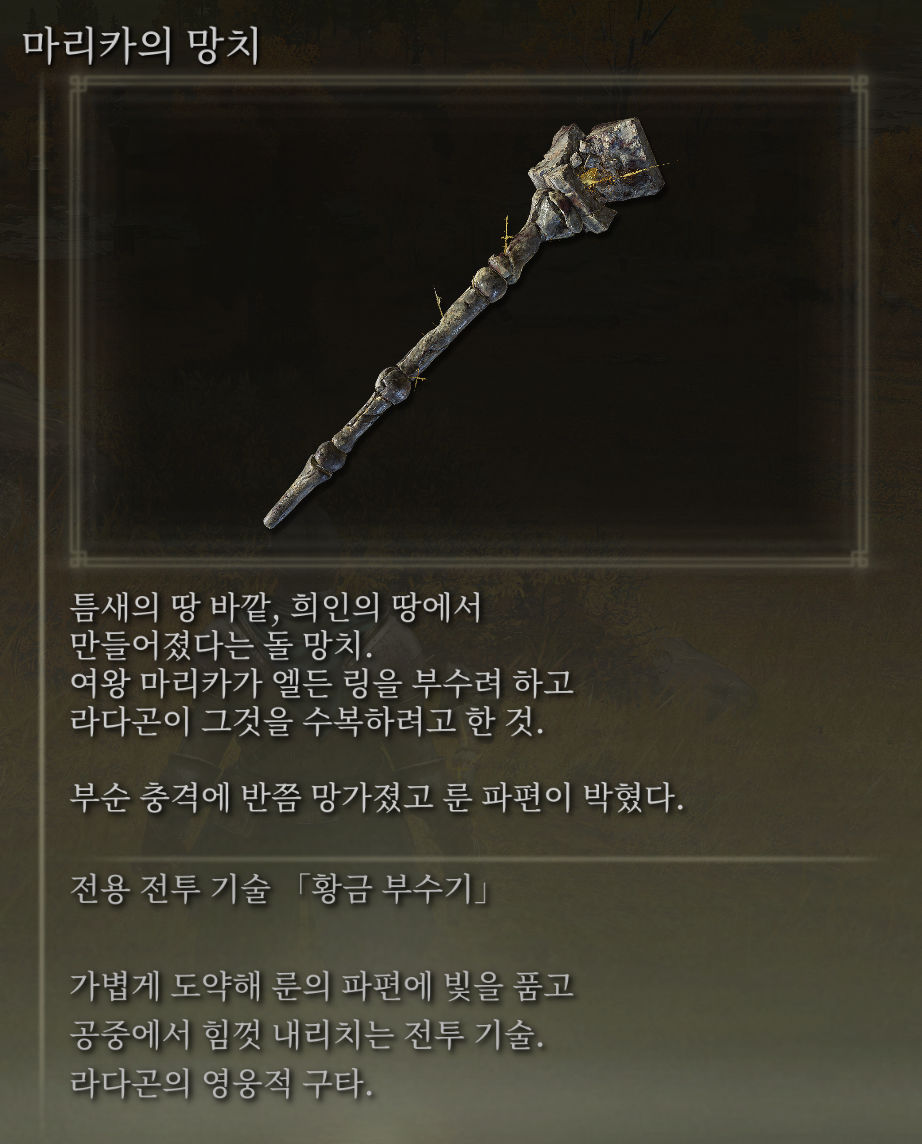 Marika's Hammer in the Korean game. The description assigns breaking and repair to different agents. Original inventory screen shared by 좋은 열매. © Bandai Namco Entertainment / FromSoftware. Image source ↗
That is a problem for any explanation that treats Radagon's repair as straightforward proof that Marika wanted the resulting world preserved indefinitely. To make that argument, we would first need to explain why his repair expresses her intention. The item does not tell us that destruction and repair were an agreed joint strategy.
Their intimate connection does not erase the distinction. In another echo delivered by Melina, Marika addresses Radagon, says he has yet to become her, and calls for them both to be shattered. She also calls him “Mine other self.” These words make the relationship more complicated than two unrelated opponents, but they do not make every action an expression of a single shared purpose.
The promise that predates the broken Ring
Melina's echoes are not fresh orders from a present-day Marika. She introduces them as words left behind by the queen. In the church conversation about exile, she relays Marika's declaration that her lord and his warriors will lose their grace and leave the Lands Between to fight and die elsewhere.
A second church conversation supplies the other half: after their deaths, Marika will return what she took. They are to come back, fight, and take up the Elden Ring. The official game introduction places the exile before the shattering, so this is evidence of a return envisaged before the catastrophe, not merely a response invented in its aftermath.
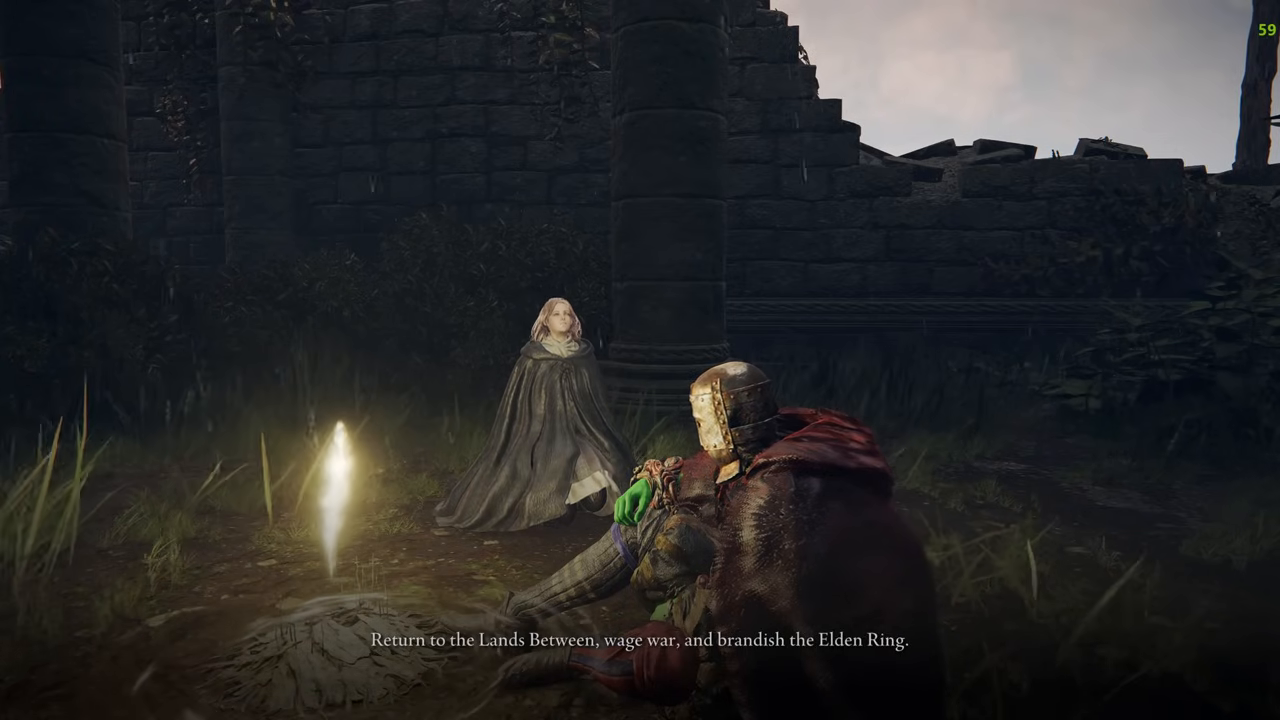 The return promise, heard through Melina. Native English game subtitle, recorded by Games from Mars. © Bandai Namco Entertainment / FromSoftware. Image source ↗
It is a striking promise. Losing grace and leaving the realm were not necessarily the end of these warriors' usefulness to Marika. Their later return already had a place in her words.
Yet the promise does not mention assassinating Godwyn. It does not say that his death is a required step in recalling the warriors. Preparation for a return is evidence of that preparation; it is not proof of authorship of every event that followed. Turning it into such proof supplies the crucial connection ourselves.
An older arrangement could have been put to a new use after a disaster. It could also have belonged to a larger design. These sources leave that relationship open. Neither possibility becomes established simply because it makes the timeline feel tidier.
What can we say Marika wanted?
The evidence supports a queen profoundly affected by Godwyn's death, responsible for breaking the Ring, and already willing to arrange exile and a future return. It also preserves a meaningful distinction between her destruction and Radagon's repair.
The strongest reading is therefore that a major loss precipitated the destruction of an order whose ruler had already prepared for returning challengers. That is an interpretation grounded in several different pieces of evidence, not a recovered confession. Precisely when those preparations became part of a plan to shatter the Ring—and what final world Marika intended them to produce—remains unproven by these passages.
For a related question where the game names a more concrete chain of consequences, see why burning the Erdtree still requires the release of Destined Death.
Official sources
- Official Age of Gods introduction and story trailer ↗2021 publisher prose on Godwyn’s loss and attached trailer narration; presentation distinguished from Marika’s own confession.
- Official game introduction ↗2026 introduction: shattering after assassination, and exile before the shattering.
- Released-game Korean hammer description — shared by 좋은 열매 ↗Original inventory text, not surrounding guide commentary.
- Released-game Melina dialogue — Games from Mars recording ↗Native subtitle frames 6:42–7:53 (exile/return) and 13:32–13:50 (Radagon address); no automatic caption used as game wording.
- Official Korean story trailer ↗Publisher channel, 45s Godwyn subtitle and corresponding cinematic still.